Anthropic’s essay, When AI Builds Itself, is important because it puts a serious frame around one of the defining questions of this era: when does AI-assisted AI development become recursive self-improvement?
Their historical outline is directionally right. In the early days, humans built AI systems directly. Then chatbots began helping with fragments of work. Then coding agents began writing and modifying files. Now autonomous agents can run code, execute experiments, delegate subtasks, and accelerate large parts of the AI development process.
That is a major shift. It changes the economics of software, research, infrastructure, and product development. A small team can now move with the leverage of a much larger organization. The bottleneck moves away from typing code and toward deciding which goals matter, which experiments are worth running, and which results can be trusted.
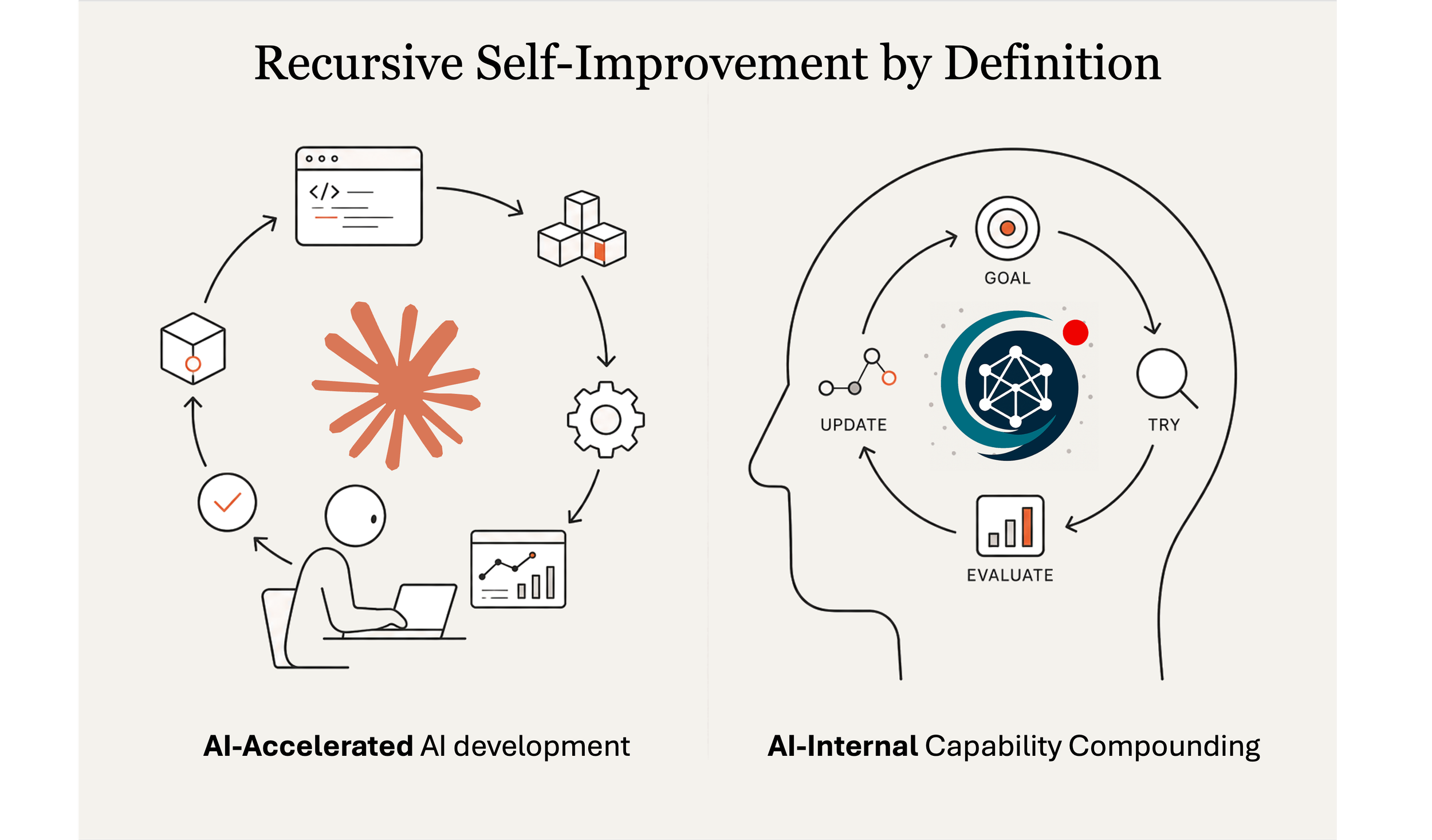
But there is a deeper distinction that matters. Anthropic is mostly describing AI-accelerated AI development. Where LatentSpin is defining AI-internal capability compounding. Those are not the same thing. An AI system writing code that improves a product is not, by itself, recursive self-improvement. An AI system helping engineers build the next model is also not, by itself, full recursive self-improvement. That may be an extraordinary acceleration of the development pipeline, but the improvement is still happening through the surrounding organization, training process, and deployment workflow.
The key question is not whether the model can write more code. The key question is whether the system can convert its own attempts, failures, discoveries, and evaluations into durable increases in its own capability. That is the real threshold.
Recursive self-improvement begins when an AI system can improve the future system that performs the next learning loop. It is not enough for the system to produce artifacts for others to review. It is not enough to fill a context window with temporary insights. It is not enough to write patches, tests, or training scripts. The system must change the intelligence that will act next. That is continual learning.
The deeper threshold is live, continuous learning. The system has a goal. It tries something in pursuit of that goal. It observes failure, success, or partial progress. It evaluates what happened. It updates its internal strategy or capability. That update persists into the model, not merely the context window. The improved version then performs better future updates, and the loop compounds its intelligence and ability (i.e. reliable weight updates). That is recursive self-improvement.
This distinction matters because today’s frontier systems can look like they are self-improving when they are actually operating inside a human-designed improvement factory. A model can generate code, run experiments, summarize failures, propose optimizations, and even recommend changes to future training runs. But unless the system’s own learning loop modifies the future system that performs the next learning loop, the recursion is incomplete.
The organization is learning. The pipeline is learning. The researchers are learning. The model may be assisting all of that. But the model is not yet necessarily learning in the sense that matters.
Anthropic correctly identifies goals and judgment as the current human bottleneck. Today, humans still define many of the objectives, choose the important problems, decide which results matter, and determine what gets deployed. That is real. But solving that bottleneck alone does not fully define self-improvement. A system could become very good at research taste and still remain static between training runs. It could choose excellent experiments, manage agents, allocate compute, write code, and evaluate results. That would be powerful. It might even automate most of the AI lab. But if its discoveries only become durable through an external retraining and deployment process, then we are still looking at automated R&D, not pure internal recursive improvement.
The phase change comes when learning is not just remembered, but absorbed.
Context is not enough. Retrieval is not enough. Tool use is not enough. Memory is not enough if it remains an external notebook. The unlock is when the system’s experience becomes part of the system’s future capability, active and live. That does not mean the only path is naive online weight updates. The durable update could involve weights, learned modules, architecture changes, generated training data, automated post-training, self-created evaluators, or other mechanisms. The implementation can vary. The principle does not.
The system must improve itself in a way that changes the learner that comes next.
This is why the phrase “AI builds itself” needs precision. There is a weak version, a middle version, and a strong version. The weak version is AI-accelerated development, where models help humans and organizations build better models faster. The middle version is automated AI R&D, where agents propose, test, evaluate, and optimize within a largely autonomous lab-like workflow. The strong version is AI-internal capability compounding, where the system’s own learning process durably and actively improves the system that performs the next learning process.
Only the strong version is true recursive self-improvement.
Anthropic’s essay is valuable because it shows how quickly the outer development loop is being automated. But from the LatentSpin lens, the decisive moment is not when AI writes most of the code. It is not when AI runs most of the experiments. It is not even when AI chooses many of the goals.
The decisive moment is when the AI’s own experience changes the intelligence that will have the next experience. That is when acceleration becomes recursion. That is when assistance becomes self-improvement. And that is when AI stops being merely a force multiplier for development and becomes a compounding intelligence system.
—
The research community has solved many things over the last decade. Continual Learning is the next great unlock…