
01
Build from your know-how
Describe the job and the outcome you want. LatentSpin drafts a workflow using the systems and permissions agreed during onboarding, so domain experts can shape the work without drawing every technical step.
Compounding Intelligence
Stop renting intelligence. Own it
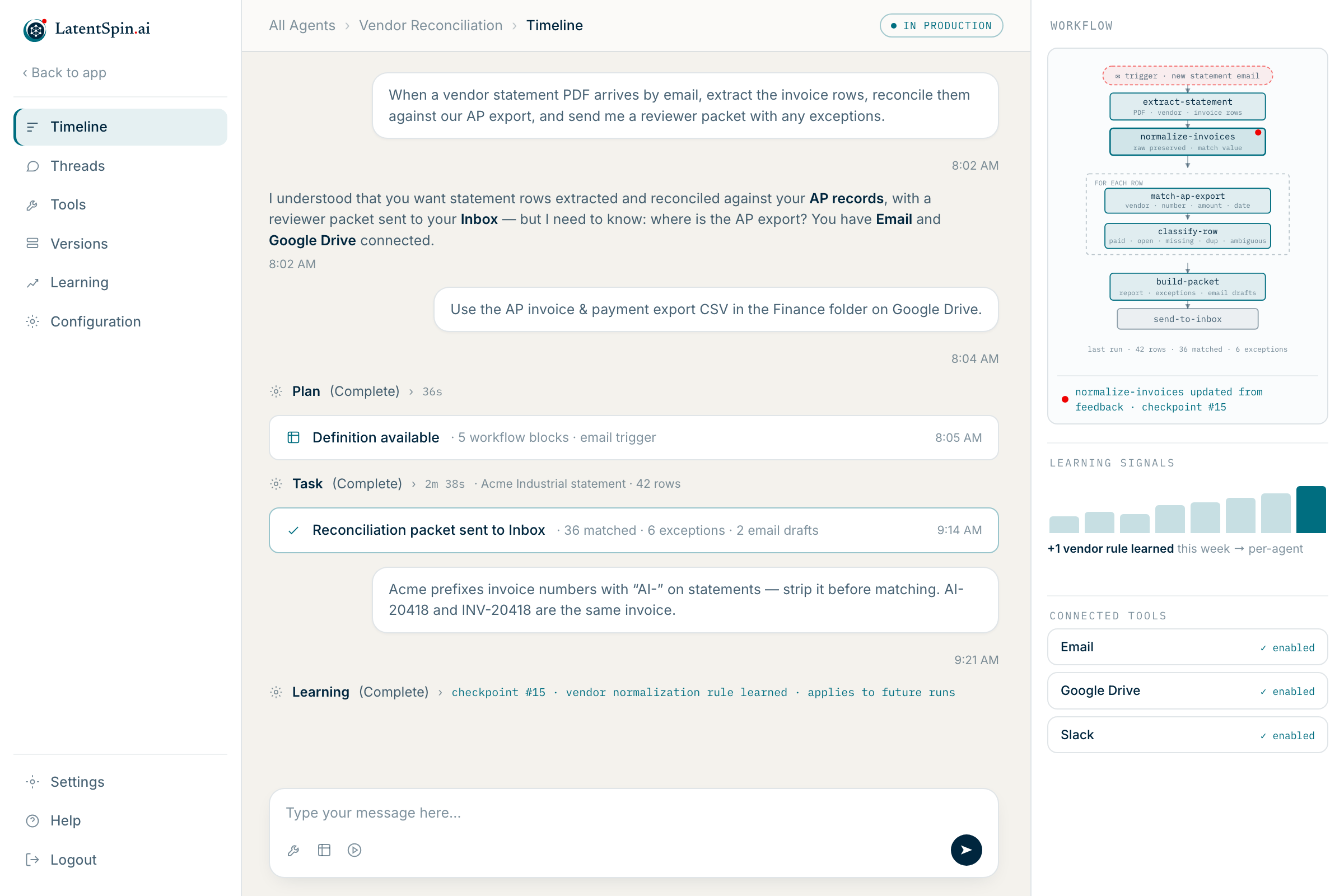
LatentSpin helps knowledge workers create agents the way they teach a teammate: define the workflow, inspect the steps, and correct real runs. Unlike static agents that rely on prompts, retrieval, memory, and context management, LatentSpin empowers Worldview Agents that learn how your organization thinks, decides, & performs. Each correction, approval, tool result, and outcome feeds a bounded in-model learning loop, turning daily work into durable operational intelligence.
Why LatentSpin
Your team knows the work. LatentSpin helps turn that know-how into workflows you can build, inspect, run, and maintain in plain language. Review the proposed steps, set approval boundaries, and teach through real corrections as requirements change.
01
Describe the job and the outcome you want. LatentSpin drafts a workflow using the systems and permissions agreed during onboarding, so domain experts can shape the work without drawing every technical step.
02
Inspect the proposed steps, dependencies, and exception paths. Decide what the agent can do and where a person must review, then follow actions and results through the execution trail.
03
Correct real work and review which lessons should persist. Bounded, evaluated, and versioned updates help agents maintain relevant expertise as policies and operating conditions change.
Your teachings improve your agents, rather than another customer’s agents. Every lesson becomes IP your organization owns.
Open-weight models and focused adapters make production execution materially less expensive than token-heavy frontier calls.
Composable blocks keep model tasks narrow, helping LatentSpin retain frontier-model performance on targeted workflows as agents learn.
The LatentSpin story
Your team brings the know-how. LatentSpin helps turn it into agents you can build, inspect, run, and teach. See how expert judgment becomes part of a workflow that can improve through real work.
Overview video
Explore how LatentSpin helps domain experts define the work, inspect the steps, and teach agents through examples, corrections, and feedback.
Watch the Overview Video ↗Workflow Signals
LatentSpin is strongest where expert work repeats often, rules change quickly, judgment matters, and mistakes create measurable cost. These are the workflows where teaching agents through review can turn daily operations into compounding company intelligence.
The work happens often enough that small improvements compound across people, teams, and locations.
Policies, markets, customer expectations, or operating conditions shift faster than static automation can absorb.
Senior judgment already exists in approvals, edits, escalations, and exceptions that can become teachable signals.
Mistakes create measurable loss through delay, rework, compliance exposure, customer churn, or missed revenue.
The organization keeps relearning the same context because knowledge lives in people, prompts, documents, or chat history.
Teams can tell whether the agent improved because the workflow already has clear outputs, corrections, and results.
Operational Reliability
Define the work, inspect each step, and decide where people stay in control. LatentSpin brings planning, execution, and governed learning into one workspace.
Set approval gates for sensitive actions and exceptions. Your team decides where the agent can act and where a person needs to review.
Inspect the actions, data, tool results, and reviewer decisions behind each run.
Improve one behavior at a time, with evaluated, reviewed, and versioned updates before promotion.
Turn expert corrections into customer-scoped learning that becomes a durable asset your organization owns.
Design partner program
Bring us one repeatable task your team knows well. We’ll work with your experts to define the workflow, review the results, and explore where teaching can improve it.
Start with one real task, clear review boundaries, and success criteria agreed together.