Enterprise agents - Platform Overview

Build workflows your team can inspect.

Your domain knowledge. LatentSpin’s agent-building expertise.

Turn the work your team knows into an agent you can direct. Describe the objective in plain language, inspect the workflow LatentSpin builds, and teach it through reviewed corrections from real work.

See the product
The product experience

Describe the work. Inspect the plan. Teach through real runs.

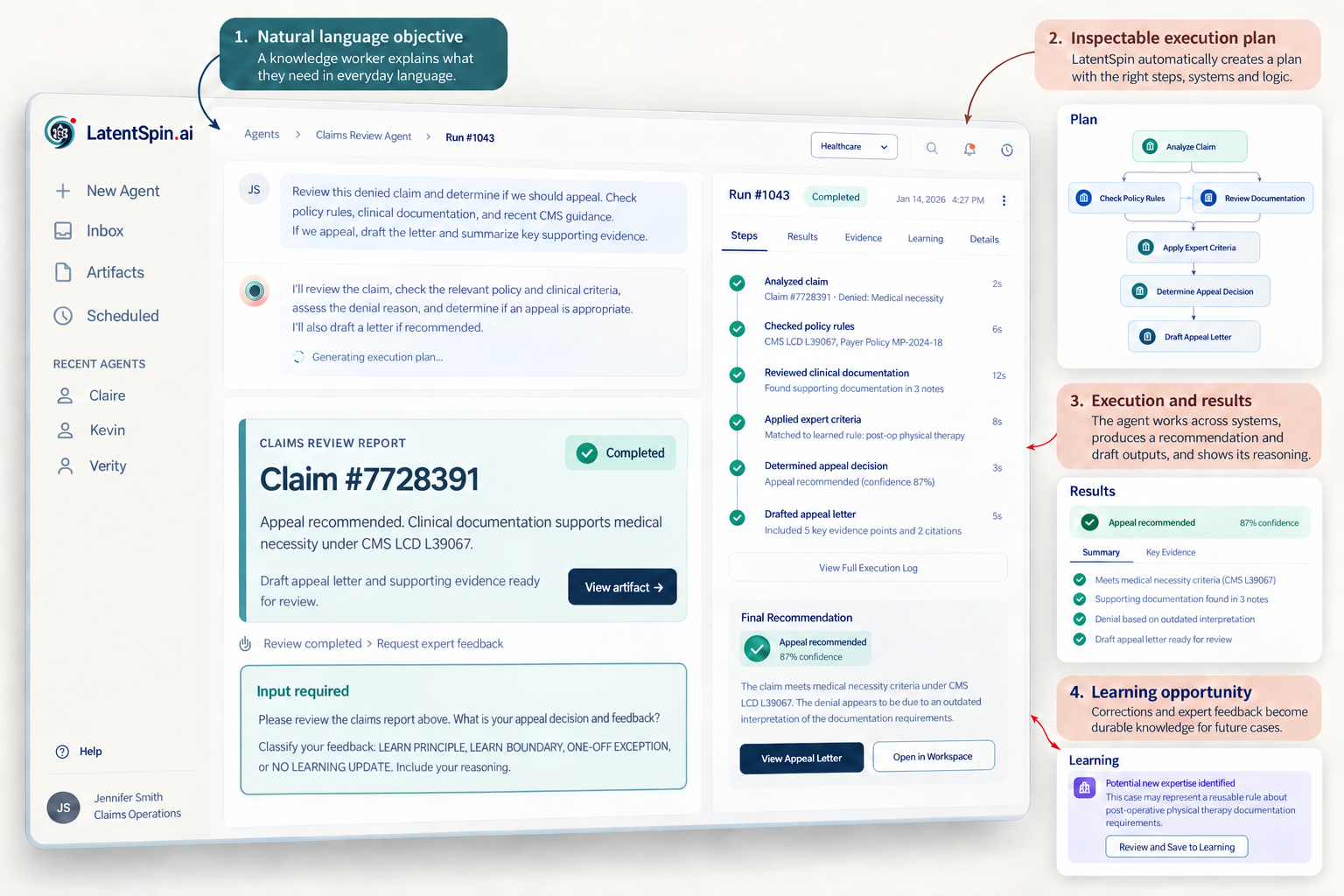
Bring the work you know. LatentSpin turns your instructions into a workflow you can review, run, and improve.

Illustrative LatentSpin claims review workspace showing a natural language objective, inspectable execution plan, execution results, and a learning opportunity
Illustrative product experience based on a healthcare claims workflow.
  1. 01 / Describe

    Bring your know-how

    Explain the goal, the information to use, and what a good result looks like.

  2. 02 / Review

    Inspect the proposed plan

    Check the steps LatentSpin prepares. Ask for changes in plain language and choose where a person must approve an action.

  3. 03 / Run

    Follow the work

    See actions, results, and supporting evidence. Review exceptions and approve decisions as the workflow runs.

  4. 04 / Teach

    Explain a correction

    Correct the work where it happened and explain your reasoning. Review what the agent should learn before an update is applied.

Building a workflow

Three ways to build a workflow.

The difference is who lays out the steps, and whether the path is set before the work runs.

Visual workflow builder

You architect the workflow.

Inputs Checks Review Result Exception
Path you build Needs technical setup

Reliable, repeatable runs once someone designs every step, connection, and exception.Reliable once someone builds every step.

General-purpose AI assistant

You delegate the task.

steps chosen as it runs Request Result
Path chosen as it runs

Quick to start in plain language; the steps in between are decided while the task runs.Quick to start in plain language.

LatentSpin

You define the workflow. LatentSpin builds it.

you inspect Your know-how LatentSpin builds Inputs Checks Review Result defined workflow
Your know-how drives the workflow Your knowledge and approvals Built by LatentSpin

Describe how the work should be done. LatentSpin engineers a defined workflow from it; you inspect it and ask LatentSpin for changes in plain language.Your know-how defines it; you inspect it and ask for changes.

Your corrections on real runs also teach the agent, without changing the workflow you approved. Connections and permissions are set up with your team during onboarding.

Compare responsibilities in detail
The job Workflow builder AI assistant LatentSpin
Arrange the steps A builder connects steps, branches, and dependencies. The assistant chooses steps as it works. LatentSpin proposes readable steps; your team reviews and refines them.
Connect systems Someone configures integrations, credentials, and data mappings. Uses the connectors and permissions it has been given. LatentSpin sets up the agreed connections with your team during onboarding; your IT approves access.
Handle exceptions A builder defines conditions, retries, and routing. Handled as the task runs. Exception paths are part of the proposed plan; you choose which go to a person.
Run and maintain Same path every run; changes need workflow edits. The path can change between runs. Same approved path every run; corrections become reviewed lessons.

Illustrative comparison of approach categories; individual products and configurations vary.

Improving an agent

Keep the lesson, not just another reminder.

When a reviewer corrects the work, someone has to turn that correction into a change. The difference is who does it, and where the change lands.

Example: a correction in retail operationsA shelf-compliance agent flags an approved seasonal display. The store-operations manager explains that displays with an approved supplier tag meet the requirement.

Instructions and workflow maintenance

The correction goes to a maintainer.

  1. You explain the correction.
  2. Maintainer Queued, then the setup is revised and tested.
  3. Your team checks the change.

↺ Another round if the change isn't quite right.

Where the change lands

In the agent's instructions or workflow, edited by whoever maintains them.

Your team Maintainer, may need technical help
LatentSpin

LatentSpin turns it into a lesson.

  1. You correct the work where it happened.
  2. LatentSpin prepares the lesson and tests it on past cases.
  3. You approve the model update.
Where the change lands

In the agent's model, as a versioned update. The approved workflow stays as it was.

Your knowledge and approval Done by LatentSpin

A one-off exception can stay a one-off; your team decides what should be learned. Every update can be rolled back.

Illustrative comparison of approach categories; tools and team setups vary.

Technical detail: architecture, learning, and ownership

Explore how the workspace, execution runtime, and customer-scoped learning fit together.

LatentSpin platform architecture Domain experts use the agent workspace to direct Worldview Agents. Run signals flow up into governed learning, which promotes validated updates into open-weight models the customer owns. Agents access systems of record with scoped read-only roles. Trust and governance span every layer. DOMAIN EXPERTS Workflow owners Teach in plain language No ML skills needed AGENT WORKSPACE Describe the goal Review the plan Correct and approve runs WORLDVIEW AGENTS Automated planner Workflow blocks Tool and data calls Approval gates SYSTEMS OF RECORD Apps and APIs Core data stores Policies and documents OAuth · read-only roles goals · plan review · approvals run signals ↓ updated behavior ↑ GOVERNED LEARNING · IN-MODEL AND REVIEWED 1 Capture signals corrections · approvals · tool results · outcomes 2 Test on unseen cases 3 Promote in-model 4 Drift defense validated updates ↓ OPEN-WEIGHT MODELS · OWNED BY THE CUSTOMER Open-weight base model + Focused adapters + Weights you own inference ↑ Sovereign Your data and weights stay in your control. Learning is org-owned IP, never shared with other customers. TRUST & GOVERNANCE · SPAN EVERY LAYER Run trail · Human review · Hard guardrails · Versioned and bounded
Learning and ownership, in more detail
Aspect Context-based updates Offline fine-tuning LatentSpin
Where changes live Instructions, retrieval sources, or memory. Model weights updated through a training project. Customer-scoped model adaptations from reviewed work.
How updates are managed Testing and versioning depend on the implementation. Training data, evaluation, and release processes govern changes. Bounded candidate updates are evaluated, reviewed, and versioned before promotion.
Ownership Expertise is captured in the surrounding prompts and systems. Model and data ownership depend on deployment and agreements. Customer learning stays scoped to the organization, with ownership and handling defined in engagement terms.
Operating cost Depends on the model, context size, and workload. Includes training and serving costs. Focused adapters on open-weight models; actual economics depend on the workflow and deployment.
Security and governance

Clear boundaries. A record you can inspect.

  • Human approval: Your team sets access boundaries and decides which actions need review.
  • Visible execution: Inspect actions, tool results, decisions, and supporting evidence in the run trail.
  • Private, reversible learning: Your organization’s expertise stays private; model updates are evaluated, approved, versioned, and reversible.
Best fit

Where LatentSpin fits complex enterprise workflows

Expert work that repeats often, rules that change quickly, and mistakes that cost real money.

01

Repeated decisions

The work happens often enough that small improvements compound.

02

Changing rules

Policies and markets shift faster than static automation.

03

Expert review

Senior judgment already lives in approvals, edits and escalations.

04

Costly exceptions

Mistakes cost money through delay, rework and compliance exposure.

05

Workflow memory

Knowledge lives in people and prompts, so context is relearned.

06

Measurable outcomes

Clear outputs and corrections show whether the agent improved.

Examples include healthcare operations, financial services, retail operations, revenue teams, compliance, and professional services.
Design partner program

Build your first workflow with us.

Bring one repeatable task and the person who knows it best. We will work with your team to define the workflow, connect the agreed systems, and review what the agent can do.

Early access typically starts with one real task over roughly 1–2 weeks, with a few hours of your team’s time. Scope and success criteria are agreed together.

Build with us

Start with work you know.

Tell us what your team does today and where review or rework slows it down.