
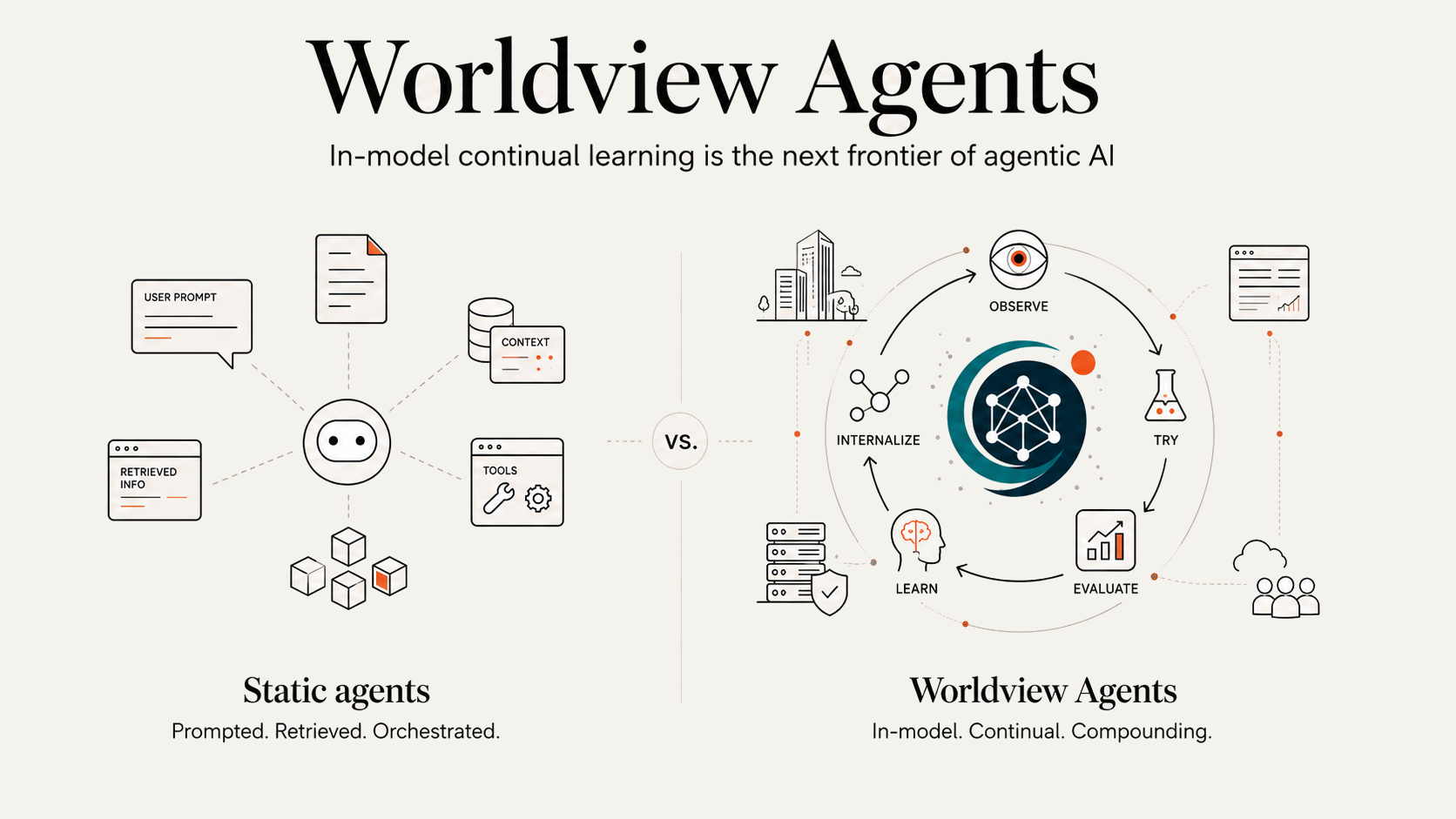
Most AI agents today are still built as task-completion systems. They receive an instruction, gather context, call tools, produce an answer, and then move on. Even when they appear sophisticated, most remain fundamentally static. They do not truly learn from the work they perform. They do not internalize the judgment of the people who correct them. They do not build a durable understanding of the environment they operate in. They simply execute the next task using whatever context has been supplied at that moment… This is useful, but it is not enough.
The next generation of AI agents will need more than memory, retrieval, tool use, and longer context windows. They will need a worldview. A worldview is the agentic form of a world model. In AI, a world model is an internal representation of how an environment works: what tends to happen, what causes what, what constraints matter, and which actions are likely to produce which outcomes. For agents, this becomes more than passive representation. It becomes operational judgment. A Worldview Agent needs a model of the workflow, the organization, the domain, and the consequences of action. It must understand not only the current task, but the system the task belongs to.
At LatentSpin, we define Worldview Agents as agents that develop an evolving, in-model understanding of the environments they operate within. A Worldview Agent does not simply remember prior interactions. It learns the operating logic of a domain. It understands the goals, rules, exceptions, tradeoffs, risks, and decision patterns that shape how work actually gets done. It improves through real execution, expert feedback, corrections, and outcomes. Over time, the agent does not merely become better prompted. It becomes better trained.
This distinction matters because real work is not stateless. A healthcare revenue cycle specialist does not process claims by following one static rulebook. Payer rules change, denial patterns shift, authorization requirements vary by plan and state, and experienced billing experts develop judgment that is hard to write down. An enterprise IT operations engineer does not triage incidents by reading a generic runbook. They understand which alerts matter, which are noise, which deployment patterns are risky, and which failure signatures tend to precede a serious outage. A logistics manager does not manage freight exceptions through fixed automation. Carrier rates change, port delays emerge, fuel surcharges shift, customers require different handling, and market conditions evolve daily… These are not just tasks. They are living environments.
Traditional agents are poorly suited to living environments because they are built around frozen models. Once trained, the model’s underlying behavior is fixed. When the environment changes, the system must compensate by adding more prompts, more retrieval, more memory, more orchestration, and more context. This creates the illusion of learning, but it is not learning. It is context management.
Context management can help an agent perform a task, but it cannot give the agent a true worldview. A context window can tell the model what happened before. Retrieval can fetch relevant documents. Memory can store facts from prior sessions. A workflow engine can sequence tool calls. But none of these mechanisms, by themselves, change the model’s internal understanding. They do not turn repeated experience into durable capability. They do not convert expert judgment into learned behavior. They do not allow the agent to become structurally better at the work.
This is why many agent systems look impressive in demos but struggle in production. In a demo, the workflow is clean, the examples are curated, and the environment is controlled. In production, the environment changes. Exceptions multiply. Policies update. Data arrives incomplete. Customers behave unpredictably. Operators make judgment calls that are obvious to experts but invisible to a static model. Over time, the agent needs more and more context to perform the same work. Costs rise, latency increases, prompts become brittle, and accuracy begins to depend on how well the system can stuff the right information into the model at the right moment… That is not compounding intelligence. That is operational debt.
Worldview Agents take a different path. They treat execution itself as the learning surface. Every workflow run becomes an opportunity to improve. Every expert correction becomes a teaching signal. Every approval, rejection, edit, escalation, and outcome becomes evidence of how the domain actually works. The system observes not only what the human did, but why the human did it. It learns which factors mattered, which rules were applied, which exceptions were meaningful, and which patterns should influence future behavior.
For that to work, the learning must become durable. It cannot live only in a prompt. It cannot live only in a memory store. It cannot live only in a retrieved document. A real worldview requires in-model continual learning. World models, by definition, cannot remain frozen in environments that keep changing.
In-model continual learning means the agent can convert validated experience into persistent model capability. The model itself becomes better at the task because the knowledge has moved from temporary context into learned behavior. This is the difference between an agent that must be reminded of a rule every time and an agent that has internalized the rule. It is the difference between an agent that retrieves a correction and an agent that has learned from the correction. It is the difference between software that executes and intelligence that compounds.
A useful way to say this is: memory remembers what happened, but a worldview learns what matters.
That is the heart of the shift. A Worldview Agent does not need to carry every prior example into the context window because the repeated, validated patterns have become part of how it acts. It still uses context, but context is reserved for the live situation: the current user, task, document, customer, workflow state, system output, or exception. Durable knowledge belongs in the model. Temporary execution state belongs in context.
This is why LatentSpin’s architecture centers on collaborative workflows and composable, inspectable blocks. Knowledge workers need a way to teach agents without becoming software engineers or machine learning specialists. They need to define what the agent should do, inspect how it behaves, correct it when it is wrong, and validate improvements over time. Composable workflow blocks make this possible because they break complex work into understandable units. Each block becomes both an execution unit and a learning surface. The agent can improve one behavior at a time without destabilizing the entire workflow.
This is also why the term “Worldview Agent” is important. The market already has too many labels for assistants, copilots, bots, automations, orchestrators, and agent frameworks. These systems are still built around static intelligence. They may act, but they do not truly adapt. They may remember, but they do not truly learn. They may automate, but they do not compound judgment.
Worldview Agents turn expert work into evolving model behavior. They are not just agents that do more. They are agents that learn what matters.