
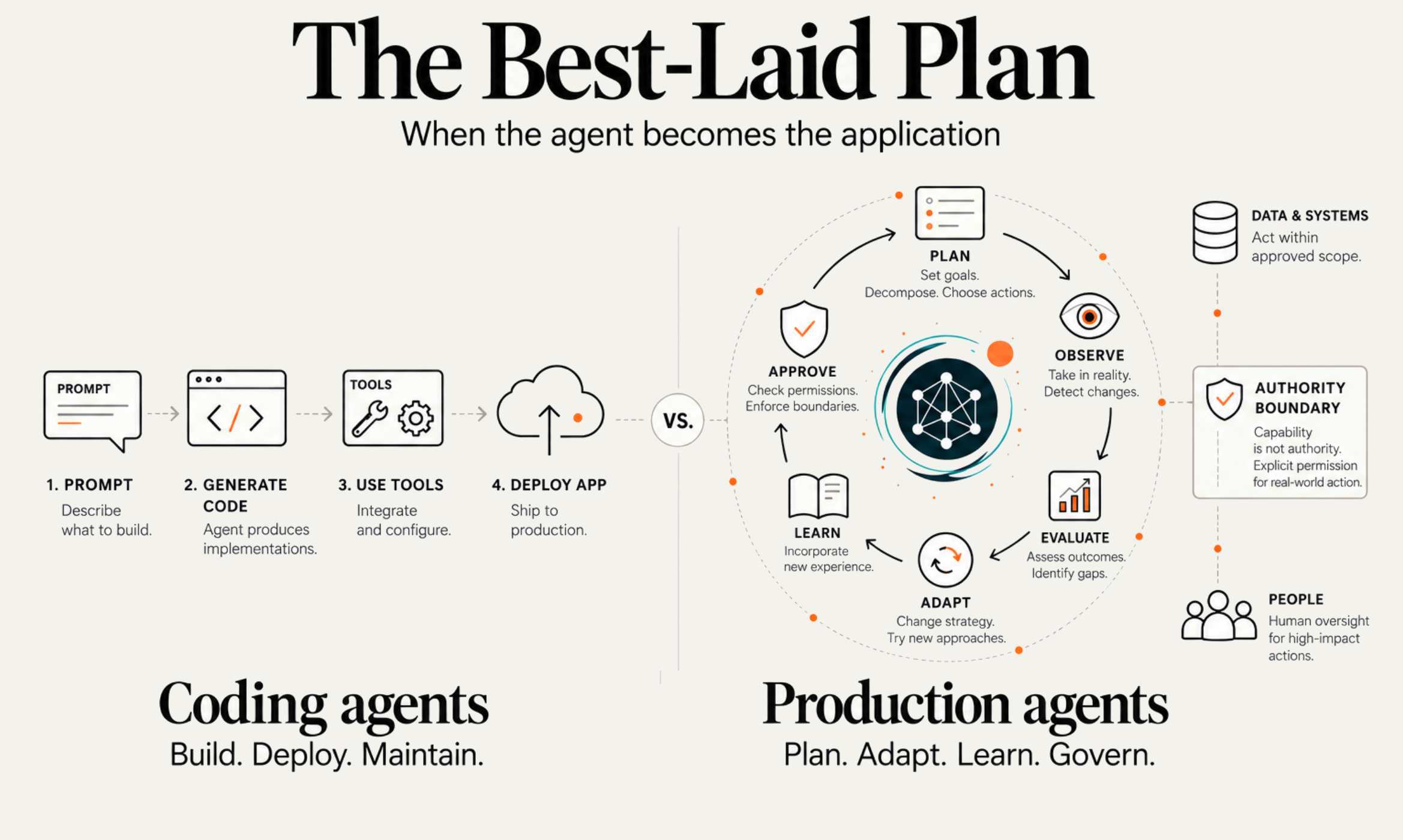
Generative AI has changed the economics of building software. Coding agents such as OpenAI Codex and Anthropic Claude Code can take a description of what someone wants, reason through the problem, write code, use tools, test the result, and increasingly handle large portions of the software development lifecycle. Let me say that again… development cycle.
That is a major optimization, but the basic paradigm is still the same:
- Requirements become software
- Software becomes an application
- Application performs the work
LatentSpin starts from a different premise. For a growing class of knowledge-work applications, the most important artifact may no longer be the codebase. It may be the human learned intelligence and execution behavior required to perform the job. Instead of asking an agent to build software that encodes a specific workflow, we can increasingly teach the agent the workflow itself.
That is what we mean when we say the agent is the application. The interface may still exist. Databases, APIs, infrastructure, and deterministic services still matter. But the center of gravity moves. The durable capability becomes the system's ability to understand the work, decide how to execute it, use the right tools and models, learn from feedback, and produce the desired result.
Coding agents generate code. LatentSpin generates results.
Traditional application code gives us determinism by encoding execution paths in advance. That determinism is valuable, but it is also static. When conditions change, the code has to be changed. An agentic application can preserve deterministic execution where it matters by versioning and locking execution plans, while still remaining dynamic in how it selects, composes, or adapts those plans as the work changes. The goal is not to trade determinism for flexibility. It is to separate them, so the system can be deterministic where it should be and adaptive where it needs to be.
That shift sounds simple until the agent meets production.
The best-laid prompt meets reality
A prompt can describe what good behavior should look like. It can explain the task, define constraints, identify trusted sources, describe the desired output, and tell the model how to reason about the work. For a demo, that can be enough to produce something impressive.
Production is different. Sources change. Tools fail. Information conflicts. Edge cases appear. A routine task suddenly becomes ambiguous. A model that handled yesterday's workload well can make a poor decision today. A plan that looked sensible at the beginning of a task can become wrong halfway through it.
This is why the best-laid prompt is not enough. A production agent cannot simply execute an initial plan more faithfully. It has to recognize when the plan no longer fits the world and change what happens next.
Consider a persistent AI industry intelligence system. The visible output might be a daily dashboard or briefing, but that is not the hard part. The actual job is to continuously determine what changed, which developments matter, which sources deserve trust, what deserves deeper investigation, what is fact versus interpretation, what surrounding context changes the meaning of an event, and when the available evidence is not strong enough to support a conclusion. The presentation is only one view of that underlying intelligence.
The same pattern appears across knowledge work. A financial analyst, healthcare operations specialist, support engineer, consultant, or incident responder is valuable because they can adapt judgment to changing conditions. Encoding the happy path is useful. Knowing when the happy path has broken is what makes the system production-ready.
Production agents need more than orchestration
Modern frontier agents already orchestrate remarkably well. Claude and Codex can reason through multistep tasks, invoke tools, gather context, create subagents, work in the background, and adapt their actions as new information appears. The argument is not that these systems lack planning or autonomy. They clearly have both.
The architectural distinction is deeper. Today’s agent systems orchestrate around a foundation model. The model is and remains the central intelligence engine inside a growing harness of tools, memory, retrieval, context, permissions, workflow logic, and external systems. The harness can change what the model sees and what actions it can take, but the model itself is treated as a fixed intelligence boundary.
LatentSpin is designed to make the model part of the orchestration itself. The system can control not only which tool should run next, but which intelligence should be used, how much reasoning effort a decision deserves, when a model should be trusted, when execution strategy should change, and when the system should stop and escalate.
Control the intelligence, not just the workflow
This is where automated execution planning and model-level control become important. The system can recognize when the model's current reasoning is becoming less coherent or reliable and change what happens next. It might gather more evidence, spend more reasoning effort, change the execution plan, invoke a different model, narrow the task, or ask a human for help. Rather than blindly continuing because the original plan said to continue, the agent can adapt how it thinks and executes as conditions change.
The point is not that every difficult decision requires the largest model available. The opposite is often true. A routine classification, extraction, or well-learned workflow may be handled by inexpensive specialized intelligence. A difficult research paper, contradictory evidence, or high-value decision may justify deeper reasoning or a stronger model. Intelligence becomes a resource that can be allocated dynamically rather than a fixed cost attached to every step of the workflow.
This also changes how we think about execution plans. A plan should not be a brittle sequence that the agent follows because it was generated first (if it was at all). It should be a living control structure. The system can determine what information to gather, what can run in parallel, which tools to invoke, what deserves more investigation, and when the original strategy should be abandoned. The best plan is the one that knows when it is no longer the best plan.
This is an important distinction. The execution graph can still be deterministic and reproducible once chosen. What changes is the agent's ability to decide which graph is appropriate, compose exceptions, or move to a new plan when conditions change. Deterministic execution and adaptive planning do not have to be opposites.
Production agents also need to learn
Adaptation during execution solves only part of the problem. A production agentic system also has to improve over time. When an agent makes the same kind of mistake repeatedly, the answer should not always be another prompt rule, another retrieved example, or another piece of application code wrapped around the model.
LatentSpin is designed to use trusted expert feedback for automated in-model training. When an expert corrects the system, provides an example, or teaches it how to think about a recurring problem, useful knowledge can move into the model itself rather than remaining indefinitely outside the model as context that must be reconstructed on every run.
That matters for accuracy, but it also matters for performance and cost. A smaller model that has learned a specific job can sometimes outperform a larger general-purpose model that has to rediscover the job from prompts, memory, and examples each time. Repeated expertise can become specialized intelligence. Stronger frontier models can then be reserved for the cases that actually require them. That also makes the underlying model replaceable: the job belongs to the agent, not the model provider.
The lifecycle changes as a result. Traditional applications evolve through requirements, code changes, testing, deployment, and maintenance. An agentic application can increasingly evolve through teaching, execution, observation, correction, learning, and improved execution. The system does not just receive new instructions. It can become better at the work.
Capability is not authority
Production introduces another boundary that is easy to miss when an agent is judged only by whether it completed the task. An agent may be capable of taking an action without having been authorized to take it. This is one reason the execution plan matters before execution begins. If the user cannot see what the agent intends to do, there is no opportunity to distinguish the desired result from actions the agent has merely inferred.
I encountered this while testing the same AI intelligence concept with Codex (gpt-6 astra). I asked it to act as an AI intelligence analyst and produce an HTML dashboard. Codex created the result, but it also deployed the dashboard to an externally hosted ChatGPT Site. I had asked for HTML. I had not asked for it to be deployed.
Had the execution plan been made explicit up front, the distinction would have been obvious: collect the information, analyze it, generate the HTML, and provide the result. Publishing that HTML to an external service would have appeared as a separate proposed action, where I could approve or reject it before anything persistent was created.
This is a production-agent problem. Once the agent is the application, the execution plan becomes more than an internal reasoning aid. It becomes an important control boundary between intent and action. The system has to reason not only about what it can do and what would be useful, but what it may do autonomously, what should be exposed for approval, and what must never be inferred from the user's intent.
The best-laid plan therefore has two responsibilities. It must be able to change when the world changes, and it must make clear what it will do and most importantly when execution is about to cross an authority boundary. A production agent needs to handle both.
The agent becomes the application
None of this means traditional software disappears. Deterministic systems will remain essential wherever repeatability, transactions, security controls, real-time performance, and hard guarantees matter. But a large class of knowledge-work applications exists for a different reason. They collect information, understand it, apply judgment, make a plan, take appropriate actions, and produce a result.
Historically, we tried to encode those jobs into software because software was the only practical way to make computers perform repeatable work. Generative AI gave us a dramatically faster way to write that software. Coding agents are giving us increasingly autonomous ways to build and operate it. The next step is to teach the agent to perform the work that the application existed to perform in the first place.
That requires more than a better prompt and more than a better workflow harness. The agent has to decide how to execute, recognize when its own intelligence is becoming unreliable, allocate the right intelligence to the problem, stay inside its authority, learn from trusted corrections, and improve over time.
The future is not simply agents that write applications. It is agents that become applications, while continuously learning how to execute those applications safely and effectively. The best-laid plan is not the answer. The ability to know what the plan is, when the plan is wrong, change it, learn from what happened, and stay within the boundaries of authority is the answer.