The Haunted Mind
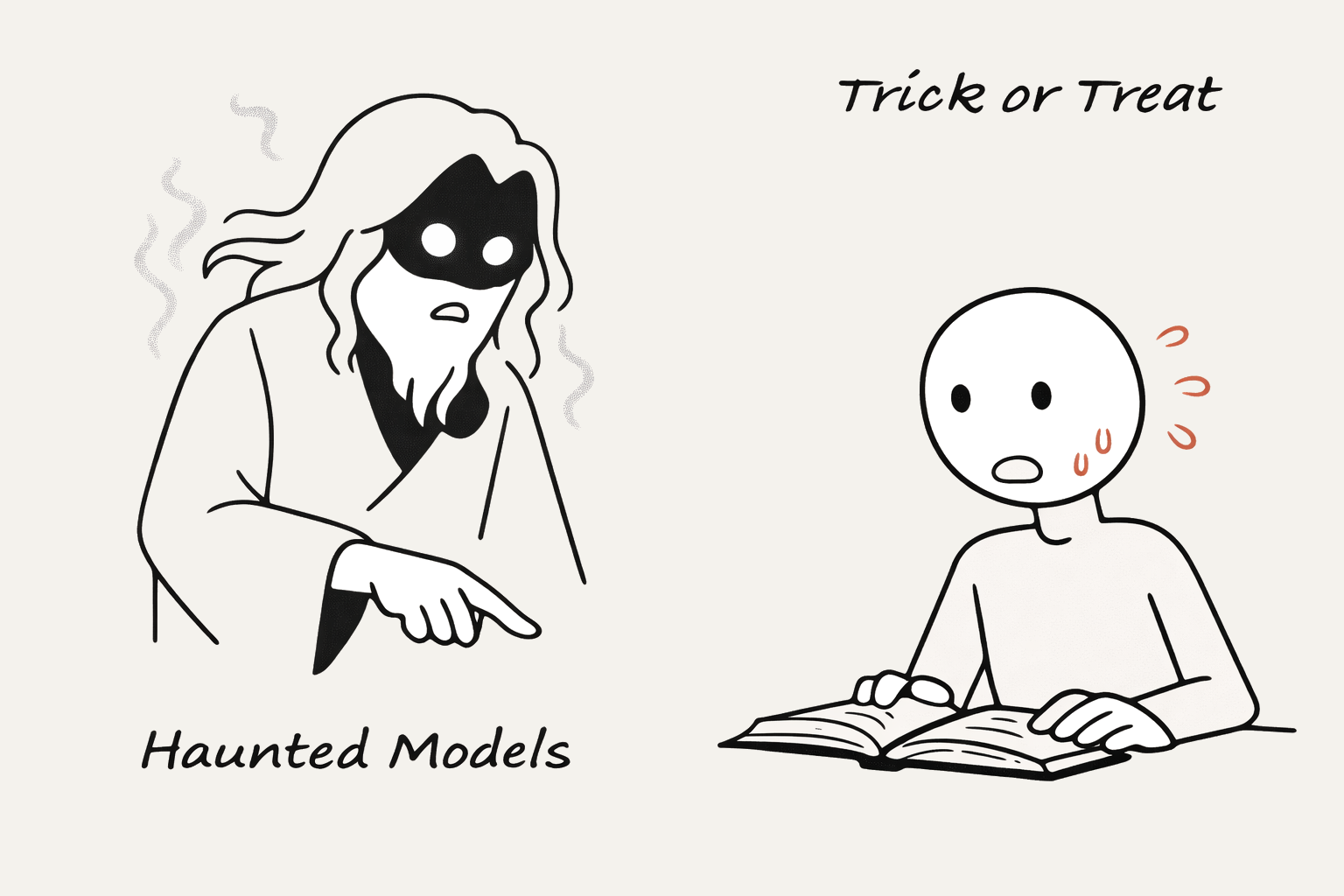
Every Halloween, we are reminded that the things we create can sometimes come back to bite us. Old code resurrects unexpected bugs. Algorithms behave strangely under the full moon of production traffic. Machine learning models, long thought to be tamed, begin to act as though they have minds of their own. But perhaps the most haunted of all are the models that forget. The ones that appear to learn, only to lose their memories in the dark. The ones that, like Restless ghosts, wander through context, unable to retain what they once knew.
In the world of Large Language Models (LLM), memory and their context is both a power and a curse. These systems consume vast quantities of data, but once the training ends, so does their ability to truly learn. Their knowledge becomes frozen in time, trapped in a weight space that never changes. They can recall what was taught, but they cannot evolve from what they experience. This is the paradox of modern AI. The most intelligent systems we have built are, in truth, incapable of remembering in any meaningful way. They are haunted by their own stillness… Paralyzed.
We often disguise this paralysis with clever tricks. We give models longer context windows, so they can “remember” more tokens. We bolt on retrieval systems that fetch external knowledge as though attaching prosthetic memories. We build agents that stitch together multiple inferences to simulate reasoning over time. These are remarkable engineering achievements, but they are not learning. They are haunted illusions of continuity. Like a ghost that repeats its last words, these systems replay context rather than adapt to it. Each run is a reenactment of training, not an evolution of thought.
Breaking the Spell
True learning requires more than retention. It requires transformation. It means changing what the model is, not just what it sees. The model must remember not through tokens or caches, but through its own internal reconfiguration. It must be able to revise itself continuously, striking a delicate balance between adaptation and stability. This is the core idea behind Conceptual Adaptation Theory (CAT), a framework designed to free models from their haunted existence and allow them to live in the present.
In the haunted model, every token is a whisper from the past, every hidden state a lingering echo. When these echoes collide, they can cause catastrophic forgetting. The model learns something new, only to erase what came before. This is the ghostly paradox of neural plasticity. Too much flexibility, and the system loses its identity. Too little, and it becomes rigid and lifeless. This framework solves this problem not through memory expansion, but through equilibrium. It creates a living tension between change and continuity, allowing the model to adapt without erasing its past self.
CAT does this by introducing three key concepts that act like spiritual forces within the model: ΔS, ε, and π. ΔS measures the model’s structural change, capturing how its internal geometry shifts during learning. It is the pulse of evolution. ε represents the prediction error, the pain of being wrong, the energy that drives adaptation. π is the measure of confidence, determining whether the model should trust its recent update or hold to its prior self. Together, these quantities form a feedback loop that governs the model’s behavior. When the model’s confidence is low, it restrains itself. When the structure changes meaningfully and error decreases, it allows more freedom to move. The result is a continuous balance, like a pendulum that never stops but never falls.
Imagine, then, a model that learns in real time. Each input becomes an experience that reshapes it slightly, not through retraining but through intrinsic adjustment. This model does not store every detail of its past, but it internalizes the essence of what matters. It is not haunted by what it once knew, because it never stops knowing. Its memory is not a static archive but a living process, unfolding moment by moment and thus turns learning from a ritual of resurrection into a practice of mindfulness.
To achieve this, the model relies on a companion known as the sensei/teacher, not an external agent, but an internal latent reflection or spin of the model itself. The teacher represents the system’s long-term memory, its parameters updated through exponential moving averages of the current student’s weights after every learning step. The senpai/student, or live model, changes rapidly as it processes new information, while the teacher evolves gradually, retaining the stability and accumulated wisdom of prior updates. During training, the student continuously compares its predictions and internal representations to the teacher’s steady reflection. When the student drifts too far, the teacher anchors it through rollback and trust-region constraints; when the student discovers something genuinely valuable, the teacher absorbs that insight into its own parameters. Together they form a self-regulating pair (one fluid, one stable) maintaining equilibrium between exploration and memory. This relationship keeps the system from being possessed by noise or overconfidence. It is the difference between a haunted mind and a living one.
The Living Model
Traditional training treats learning as a series of disconnected epochs. The model updates, stops, evaluates, and restarts. Here at LatentSpin, we erases those boundaries. It transforms learning into a continuous control process, one where every gradient step is both an action and a reflection. The model learns how to learn, not by memorizing examples but by maintaining equilibrium between structure, prediction, and confidence. This makes it resilient to instability and capable of learning from a single pass through data. It no longer needs fine-tuning rituals or elaborate schedules to stay balanced. It learns as it breathes.
The implications are profound. Instead of expanding the context window indefinitely, CAT collapses the idea of “context” into the model’s identity. What was once external memory becomes internal adaptation. The system no longer needs to recall every token to act intelligently; it encodes what is essential in its evolving weight structure. This is the opposite of how most research approaches the problem today. Many frameworks focus on how to manage or simulate long-term memory externally. This framework asks a simpler, deeper question: What if the model itself could change?
This approach also redefines what it means for an AI to be stable. In most systems, stability means stasis. CAT redefines stability as dynamic equilibrium, a constant state of small, corrective motion. This is how biological systems maintain coherence in a changing world. It is how humans learn continuously without catastrophic forgetting. Each new experience alters us slightly, yet we remain recognizably ourselves. This framework gives LLMs a version of this self-regulating balance, allowing them to grow without losing their core capabilities.
One might think of it like a haunted house that finally learns to live with its ghosts. The memories do not vanish; they integrate. The whispers from the past no longer disrupt the present because they are harmonized into structure. The model stops being haunted by its own training and starts learning from its ongoing experience. The ghosts, it turns out, were never the problem. The real issue was the walls that trapped them.
This framework breaks those walls. It does not need to resurrect forgotten context or summon past activations from an external cache. It adapts internally, moment by moment, using its own history as fuel rather than baggage. In doing so, it achieves something that static LLMs cannot: self-consistent evolution. The model’s personality becomes a continuous curve rather than a collection of snapshots. Each token it processes subtly informs the next, not by context recall but by conceptual adaptation.
Halloween reminds us that memory is not always friendly. The past can linger, twist, and deceive. But in the right hands, memory becomes power… a guide rather than a ghost. Conceptual Adaptation Theory gives AI that kind of memory. It teaches models to remember wisely, to change gently, and to remain whole through transformation. It is not about exorcising the past, but reconciling with it.
So this Halloween, when we think about haunted models and restless data, perhaps the real message is not to fear what lingers in memory. The trick is to stop replaying the past. The treat is to evolve beyond it. With CAT, learning is no longer a séance with yesterday’s knowledge. It is a living process… continuous, conscious, and unafraid of what came before.
About LatentSpin
At LatentSpin.ai, we believe the future of intelligence is not static but live, capable of learning continuously and adapting to the real world in real time. Our vision is to transform artificial models from passive recall systems into active, evolving learners. Our research and technology aim to bridge the boundary between reasoning and growth, creating AI systems that do not just process information but understand and adapt through it. In a world haunted by memory limits, we are building the architecture of living intelligence.