
1. Introduction: The Single-Model Assumption
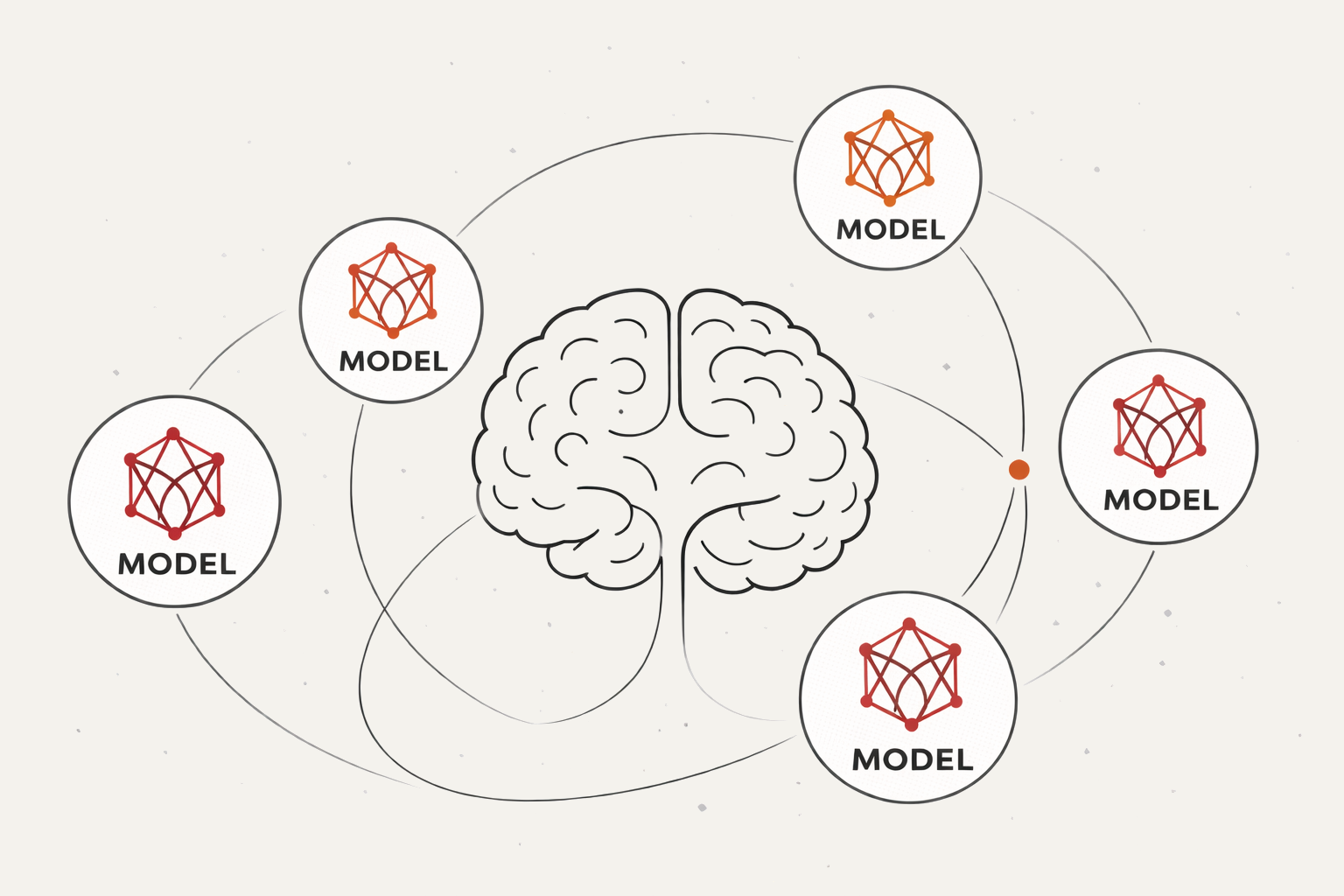
When talking about AI agents, it often feels implied that these agents are backed by a single LLM. This feels natural since AI agents are so frequently compared to humans, and humans only have one brain (of course!). This is also exacerbated by the fact that most AI agent examples and guides you can find also use a single model to drive their workflows. One model plans, reasons, executes, validates, and responds.
That single-model view is a simplification, though. In production systems, multi-model architectures are becoming the norm. Part of the driving force is related to how folks are integrating models to architect reliable agents. Another motivation has to do with the success we’re seeing in smaller specialized LLMs (or even SLMs).
For instance, a data-analysis agent might first retrieve a dataset, summarize key trends, and then produce a formatted report. None of these subtasks require deep open-domain reasoning. They benefit more from speed, precision, and consistency. Hosting multiple specialized models, or one model with several fine-tuned adapters, is increasingly practical too. Inference servers such as Ollama and vLLM make it straightforward to load several smaller models in parallel or switch adapters dynamically. Each component can specialize in a different part of the agent’s workflow.
At LatentSpin, we approach agent design as an architectural problem. We build agents from hardened, composable workflow components that can specialize, evolve, and improve independently over time. Between the reliability advantages of specialized models and the speed and cost savings smaller models afford, multi-model agent design makes a lot of sense.
2. From Monoliths to Specialists
Large models like GPT-5 or Claude are trained to do almost everything. That generality is their strength, but it is also what makes them inefficient for agent systems that perform repeatable, well-scoped tasks.
Most agent workflows do not need broad general knowledge at every step. Parsing a JSON schema, summarizing a meeting, or validating a structured answer does not require encyclopedic reasoning. These tasks call for consistency, precision, and speed. Smaller, fine-tuned models handle those requirements well.
When an agent relies entirely on a single large model, several challenges appear:
Latency and cost. Bigger models are slower and more expensive per call, which limits scalability.
Behavioral drift. The model might generate different reasoning chains or structures for the same input, making debugging difficult.
Complex fine-tuning. Training a massive model to learn new behaviors or knowledge can cause regressions in unrelated capabilities.
By contrast, smaller models can be specialized and swapped like modules. A small model fine-tuned for text classification can outperform a large general-purpose model on that same task, at a fraction of the cost.
This approach does not replace general models entirely. The goal is balance: use the larger model for broad reasoning or synthesis and surround it with smaller, task-tuned components. The result is an agent that behaves as a composed system rather than a single black box.
3. Decomposing the Agent Workflow
A modular agent design starts by breaking down the workflow into clear stages that require different kinds of knowledge and tool interaction. Each stage can be powered by a model—or even an adapter layer—tuned for that role, sometimes paired with external tools.
Consider a research assistant agent that produces competitive intelligence summaries for a marketing team:
Retriever / Context Builder: A smaller model specialized in document search and ranking works alongside a vector database or retrieval API. It assembles relevant materials from internal wikis, sales notes, or public filings. It needs domain-specific retrieval logic and ranking heuristics, not deep reasoning.
Interpreter / Planner: A larger reasoning model (for example, a fine-tuned 14B or 20B general model) reviews the materials and decides how to structure the workflow. It may call out to APIs for data enrichment or prompt other components, defining which tools to invoke next.
Analyzer / Executor: A compact model trained on structured data performs calculations, generates visualizations, or invokes external analytics tools. It focuses on correctness and schema compliance rather than natural language flow.
Summarizer: A model fine-tuned on marketing reports and corporate tone converts structured findings into narrative form. It may use templating or text-generation APIs to ensure consistency with brand style.
Validator: A lightweight rule-enforcing model checks for completeness, formatting, and factual consistency, sometimes invoking comparison tools or external validators to cross-check references.
Each of these models operates on a narrow domain of knowledge and coordinates with its relevant tools. Together they function like a small organization with specialized roles and resources: the retriever gathers evidence, the planner assigns tools and tasks, the analyzer performs work, the summarizer crafts the story, and the validator ensures quality.
This division of labor enables targeted iteration. If the retrieval pipeline lags, retrain or replace the retriever model and adjust its search tool integration. If summaries drift off-tone, refine the summarizer and its templates. Each piece evolves independently without destabilizing the rest of the system.
4. Fine-Tuning Trade-offs: Large vs Small Models
Fine-tuning is where the advantages of modularity become most visible.
When fine-tuning a large general model, the dataset must cover every type of knowledge or behavior you want to preserve. Even small biases in data distribution can cause regressions: a new behavior learned at the cost of an old one forgotten. The training process is computationally heavy and slow, making iteration expensive.
By contrast, fine-tuning a small, purpose-built model simplifies some things. The dataset can stay narrow and high quality – maybe only a few thousand examples of flawless JSON validation – because the model needs to master exactly one motion. Training finishes quickly on modest hardware, which means iteration feels lightweight. Most importantly, updates stay isolated: when the summarizer gets sharper, the planner doesn’t suddenly forget how to structure tasks.
There is also a data-science advantage. Smaller fine-tunes are easier to monitor. Their success metrics are clear (“Is the output schema valid?”), and regression testing is faster to automate. Instead of one large model where every change risks unintended side effects, you get a collection of predictable, testable components.
Fine-tuning becomes less about managing complexity and more about targeted iteration. Each component learns exactly what it needs, no more and no less.
5. Architecting for Modularity
Multi-model agents mirror what happened in software engineering with the rise of microservices. Early systems bundled all functionality into one monolithic application. It worked, but as systems grew, that approach became brittle. Teams began decomposing their applications into services that could scale, update, and fail independently.
The same logic applies here:
Encapsulation: Each model handles one responsibility.
Interfaces: Clear schema-based contracts define how models communicate.
Isolation: You can retrain or swap a model without affecting the rest of the agent.
A well-architected multi-model agent often resembles a distributed system. Each model runs as a service (or microservice) within an inference cluster, possibly sharing a memory layer or tool registry. Encapsulation keeps every model focused on one responsibility, interfaces give them clean schema-based contracts to hand off work, and isolation lets you retrain or swap a model without disturbing its neighbors. In a modular AI architecture, data and context flow through those interfaces rather than through sprawling prompts.
This modular architecture also opens doors to cross-agent composition. Different agents can share specialized submodels – for example, the same validation model could serve multiple workflows, or a retrieval model fine-tuned on company knowledge could power both customer-support and sales-assistant agents. This reuse encourages consistency while still allowing independent evolution.
Ultimately, modularity turns agent design into a form of system architecture. It encourages teams to think not about prompts and responses, but about components, interfaces, and flows. The result is an agent that is more resilient, maintainable, and ready for continuous improvement.
6. From Practical Benefits to Composable Intelligence
Building agents from multiple fine-tuned models brings immediate, tangible benefits. Smaller models reduce infrastructure costs and shorten iteration cycles because training one component can take minutes instead of days. Each module has a clear purpose, which improves observability and debugging. Updates remain controlled: you can replace a summarizer or validator without revalidating the entire stack. Experiments become safer and faster, allowing teams to refine parts of the system without risking stability.
These advantages create a steady rhythm of progress. Agents improve in small, measurable steps, similar to how well-managed software systems or teams evolve over time.
And the broader opportunity is composable intelligence. By orchestrating smaller, fine-tuned models, teams can design agents that grow through specialization and collaboration. Each component becomes a point of learning, validation, and improvement. Over time, these systems absorb new skills, share submodels across workflows, and adapt without the need for full retraining.
This philosophy of composable intelligence is shaping how we design and deploy every LatentSpin agent. In upcoming posts, we’ll show how these modular systems continuously learn from real-world use.