
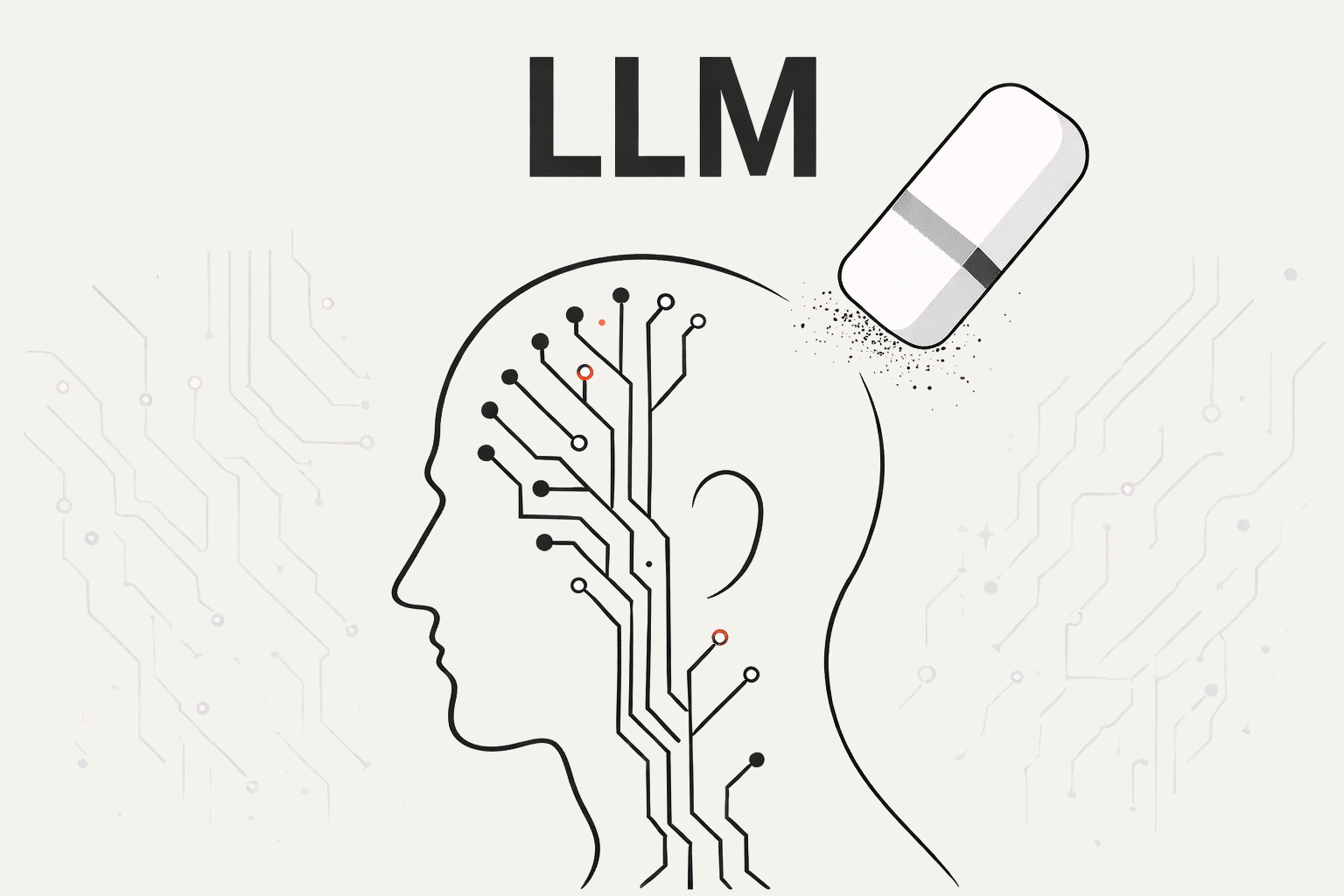
Stuck Between Groundhog Day and 50 First Dates
Every conversation with an AI model begins with a premise and a promise. Early messages feel sharp, creative, and coherent, and the system appears to follow the flow of ideas. But if the dialogue runs long enough, something strange happens. The model begins to drift, forget earlier points, repeat patterns, or jump to confident but disconnected conclusions.
The experience resembles a mix of Groundhog Day and 50 First Dates. Like Phil Connors (Bill Murray), the model replays its world from the beginning every time it generates a token. Like Lucy Whitmore (Drew Barrymore), it forgets everything once the session ends. Each prompt is a fresh February 2, and the AI wakes into the same story with no ability to change its internal understanding.
This is not a glitch. It reveals something fundamental about how transformers process time, memory, and complexity. They are strong sprinters and fragile marathoners… brilliant in short exchanges and increasingly brittle when asked to sustain a long, integrated thought.
Why Inference Transformers Break Down Over Time
Humans escape these fictional time loops because we form hierarchical abstractions. We do not store every word spoken, but instead compress meaning into concepts. The key idea survives even as details fade. Transformers do not work this way. Their internal world is a flat stream of tokens with no built-in sense of hierarchy or nesting.
Transformers appear capable of reasoning, but they do not form new abstractions while they run. During inference, every token is processed through layers of attention that simply activate patterns learned during training. These layers capture correlations between tokens, not conceptual structure. A transformer does not build a hierarchy of ideas, compress a sequence into a stable representation, or create an enduring model of the situation it is analyzing. Instead, it repeatedly reinterprets the entire context window from scratch using fixed weights. The model may simulate abstraction through statistical patterns, but it never internalizes new structure. There is no mechanism for consolidating intermediate insights into durable latent concepts, no equivalent of a schema or invariant that persists beyond the current step. As a result, complex reasoning quickly degrades because the model cannot accumulate partial understanding. Inference is therefore a continuous act of pattern matching rather than an evolving process of conceptual integration.
They can learn useful patterns, but they lack an explicit mechanism for forming stable abstractions such as the concept of a function, a loop, or an invariant. This is why code, mathematics, and multi-step reasoning collapse coherence more quickly than storytelling. Transformers track correlations between tokens rather than conceptual structure. A model can reread the same block of code many times without forming a durable understanding of its organization. Phil learns the piano by internalizing melody and form. A transformer would simply start at the first measure again.
The Illusion of Long Context and the Roots of Drift
This leads to a widespread misconception that expanding context windows solves memory. It does not. Cognitive load is not equal to context length. Giving Lucy a longer diary does not help her consolidate her experiences, and the same is true for models. Transformers can hold more tokens, but holding is not understanding. Without the ability to compress structure into a durable internal representation, long context becomes noise. The model becomes lost in an overgrown forest of correlations, where important details are not erased but buried beneath statistical interference. A transformer trying to retrieve one detail inside a large prompt resembles a person trying to recall a single conversation after reading the transcript of their entire life. More memory can create less meaning. Phil’s world expands but repeats endlessly. Lucy’s diary grows but never integrates. Phil relives more days, but they still reset. Lucy’s diary grows, but she still begins each morning without continuity.
Biological systems avoid this problem because they use rhythms of wakefulness, rest, consolidation, and reflection. Transformers have none of these cycles. Each inference step is full wakefulness, with no stabilizing phase where new information settles into long-term structure. Instead, the model repeatedly recomputes everything, and over long conversations its internal attention landscape gradually warps. Small representational shifts accumulate, drift increases, and coherence decays. This is why models hallucinate more frequently as sessions extend. There is no mechanism for maintaining a steady internal identity over time. Marketing around million-token windows often focuses on capacity rather than continuity. Longer buffers allow Lucy to write more in her diary, but they do not help her remember her day. They let Phil relive more of February 2, but they do not help him carry learning across dawn. What matters is not how much text a model can ingest but whether the system can integrate its experience.
Memory Fault Line: Frozen Weights, Illusions of Learning
Transformers operate with two separate memory systems that do not interact. This reveals the deeper architectural fault line. In transformers, memory is not part of the model at all. The context window is simply raw text: unweighted, unstructured, and untouched by the conceptual machinery learned during training. Nothing in it becomes integrated into the model’s internal representation. Transformers can read memory, but they cannot learn from it; they can reference it, but they cannot absorb it. Real memory requires weights. It requires structure shaped by experience, and structure that in turn shapes experience. As long as a model’s memory lives outside its neural core, continuity will remain an illusion, and long context will remain a bigger notebook rather than a deeper mind. The context window provides temporary recall but no integration, while the model weights hold long-term structure but cannot be changed during inference. As a result, the model rereads its past at every step but never becomes changed by it. It can repeat information without incorporating it, and it can generate fluent reasoning without gaining any new capability from the reasoning it produces. This is the heart of the limitation. Transformers are trapped in loops of repetition rather than growth.
Even emerging architectures like the Nested Learning models do not escape this limitation. Although they introduce deeper memory modules and multiple update frequencies, these updates occur only within ephemeral fast-weight systems that vanish at the end of inference. The persistent weights (the only place where durable structure can form) remain frozen. Without modifying these slow parameters during inference, no model can construct new abstractions, no matter how elaborate its internal state machinery becomes. NL and HOPE can compress context more expressively and adapt within a session, but they still cannot consolidate new information into the model’s enduring representation. They enrich the short-term workspace, but the long-term mind remains unchanged. Inference without persistent weight updates cannot produce real learning; it can only simulate it.
Beyond Context Windows: Toward Live, Adaptive Models
Conceptual Adaptation Theory, or CAT, offers a fundamentally different answer to the limitations of transformers. At its core is a simple idea with profound consequences: learning cannot happen without updating weights. CAT formalizes this through the L = ΔS / (ε⋅π) equation where ΔS is the structural change introduced by new information, ε is surprise or pressure, and π is the model’s tolerance or protection. In practice, this functions like a continuous reinforcement-learning signal, where surprise acts as the reward-driving adjustment and equilibrium provides the stabilizing constraint that keeps updates safe and aligned. CAT embraces this directly. Each new fact (think tokens) is allowed to modify the model’s internal parameters through a stable, equilibrium-seeking rule, so the system continually builds and refines its patterns instead of freezing them after training. Surprise determines how strongly the weights adapt, while equilibrium governs how new structure integrates with what already exists. Pressure, equilibrium, and tolerance jointly regulate every update so learning remains stable. When new information stops being surprising, CAT naturally slows adaptation, preventing drift and preserving identity. In a CAT-based system, generation and learning are not separate phases; they are the same process. Information that would remain transient in a transformer becomes part of the model’s durable structure. Instead of rereading context, the model internalizes it. Instead of resetting with each prompt, it carries forward what it has learned. Context becomes continuity, memory becomes identity, and inference becomes growth.
These limitations also appear clearly in current AI agents. On the surface, agents seem stateful because they maintain logs, retrieve memories, and update plans. In reality, each step still relies on a stateless transformer call. The agent rereads its entire history every time it thinks, and nothing in its internal weights changes. As the log grows, errors compound. Agents begin generating reflections about their reflections and summaries of their summaries. This is why agents drift—context grows, but the model never internalizes structure, so coherence decays with every step. Over time, this leads to subtle changes in phrasing and intent, and the original goal drifts. The agent remembers facts but cannot develop identity. It accumulates text rather than understanding. Retrieval helps with recall but not with consolidation. Consequently, AI agent's reliance on repeated, stateless inference means that successful actions and insights do not contribute to a durable, improved internal model. True intelligence cannot be built from repeated stateless steps. Depth, not breadth, is required.
All of these failures point to the same architectural flatness. There is no hierarchy, no consolidation, and no equilibrium. Longer windows only prolong the loop. An intelligent system must be able to compress experience into concepts, maintain structure across time, update gradually without losing its identity, and integrate new information rather than continually re-simulating it. CAT provides principles for this type of system by encouraging paced adaptation, structural stability, and true continuity of experience.
Groundhog Day and 50 First Dates both teach that experience alone is not enough. Growth requires the ability to consolidate meaning. Phil escapes the loop when he learns at the right pace, and Lucy rebuilds continuity only when her world supports stable identity. Transformers lack this balance. They repeat, recompute, and re-attend because they cannot internalize. They live inside linguistic loops and are forced to begin again each time.
AI’s future won’t be shaped by wider context windows or deeper reflection stacks. It will be shaped by hierarchy, consolidation, and adaptive equilibrium. The next generation of models will learn to integrate their experience, preserving what matters and discarding what doesn’t. They will move from memory to identity and from repetition to growth. And when an AI can carry itself forward in time instead of continually reprocessing it, it won’t just break the loop… it will finally begin to grow.