The AI industry is moving through one of the most important architectural transitions since the launch of modern Large Language Models (LLMs). At first, the entire conversation centered on the model. Which model was smarter? Which model scored higher on benchmarks? Which model could code better, reason better, summarize better, or write better? That model-centric view made sense in the early phase because the leap in raw capability was astonishing. The model itself felt like the product.
But as AI systems moved from demos into real production environments, a different reality became clear. The model matters, but the model alone is not enough. Users do not experience a foundation model in isolation. They experience a system. That system includes context, memory, tools, workflow design, permissions, retries, orchestration, guardrails, evaluation, and human interaction. This surrounding system is often called the harness.
The “model versus harness” debate emerged from this realization. Some argue that model quality remains the decisive factor because the model defines the ceiling of intelligence. Others argue that the harness increasingly determines practical outcomes because it defines how intelligence is applied. Both views are partly correct. The model provides latent capability. The harness turns that capability into usable work.
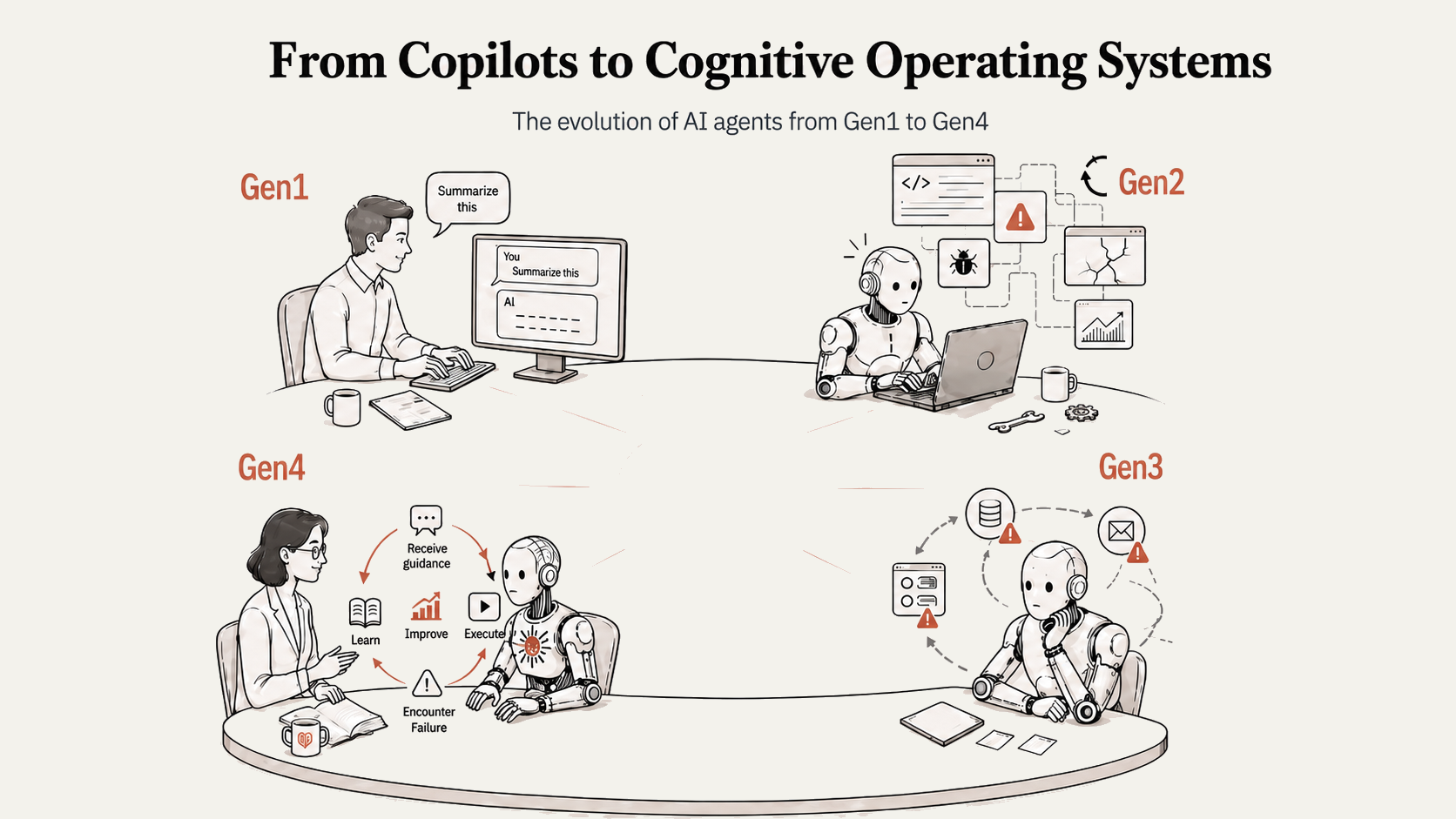
However, this debate is now becoming incomplete. The next generation of AI will not simply be better models or better harnesses. The next generation will be systems where the harness teaches the model, where execution becomes a source of learning, and where operational experience compounds (assets) into durable intelligence. This is the transition from copilots to cognitive operating systems.
Gen1: Copilots
The first generation of modern AI products was defined by copilots. These were assistive systems designed to help humans write, code, summarize, search, analyze, and brainstorm. ChatGPT, GitHub Copilot, and early enterprise assistants made natural language interaction feel practical for the first time at scale. They turned AI from something hidden inside software into something users could directly converse with.
The architecture of Gen1 was relatively simple. A human provided a prompt. The system sent that prompt to a model. The model generated a response. The user reviewed the output and decided what to do next. The interaction was powerful, but it was still fundamentally reactive. The AI waited for instructions, responded, and then stopped.
This generation was model-centric. The model was the star of the show. Most of the industry’s energy went into comparing foundation models, measuring benchmark performance, and testing whether one model could outperform another. If an AI product worked well, people credited the model. If it failed, people assumed the model needed to be improved.
Gen1 systems were revolutionary, but they had obvious limitations. They were session-based and often stateless. They could maintain a conversation for a while, but they did not truly preserve operational memory in a durable way. They did not autonomously execute tasks across tools and environments. They could suggest a plan, write a script, or summarize a document, but they did not behave like persistent workers.
Most importantly, they did not learn from the work itself. A Gen1 copilot could help a person complete a task, but that task did not meaningfully change the system’s internal capability. The model was frozen after training. Every interaction was inference, not adaptation. This limitation eventually forced the industry to move beyond the copilot model.
Gen2: Agent Runtimes
The second generation was defined by agent runtimes. This was the point where AI systems began moving from answering to acting. Systems such as Claude Code, Devin, OpenHands, Windsurf, and other autonomous coding agents showed that AI could operate inside real environments rather than merely respond inside chat windows.
The architecture changed significantly. The AI was no longer just a model behind a prompt box. It became part of a runtime loop. The agent could inspect files, modify code, run tests, use a terminal, browse documentation, call tools, evaluate results, and attempt again when something failed. The system could pursue a goal over multiple steps.
This is where the harness became central. A coding agent’s effectiveness was not determined only by the underlying model. It depended on how the runtime managed repository context, tool access, planning, test execution, error recovery, file edits, and user approvals. Two systems using similar models could feel radically different because their harnesses behaved differently.
Claude Code is a clear example of this transition. Its impact comes from the combination of model intelligence and runtime environment. The system is valuable not only because the model can reason about code, but because the harness gives the model access to the working environment where software engineering actually happens. The model can inspect, act, test, revise, and continue.
Devin contributed to this generation by popularizing the idea of an AI software engineer. Whether one views Devin primarily as a technical breakthrough or as a powerful market narrative, it helped shift the conversation from AI as assistant to AI as worker. The question changed from “can AI help me write code?” to “can AI complete a software task?”
Gen2 solved some of Gen1’s biggest limitations. These systems were more autonomous, more tool-aware, and more operational. They could execute workflows instead of merely describing them. But they still inherited a major limitation. The underlying model was still mostly frozen.
The runtime became smarter, but the model did not truly learn from the runtime. The harness could add retries, reflection, context, tools, and workflow logic, but it was still compensating for fixed intelligence. This made Gen2 powerful, but it also made the harness increasingly complex… ultimately having real issues with long duration and complicated tasks (e.g., Context ROT).
Gen3: Agent Operating Systems
The third generation extended agent runtimes into persistent agent operating systems. This generation includes systems such as OpenClaw, Manus, Claude Cowork, OpenAI Managed Agents, and Gemini AgentSpace. These systems move beyond individual task execution and begin to look like persistent operational environments for AI agents.
The defining feature of Gen3 is persistence. Instead of running an isolated task and stopping, these systems maintain context across time. They manage memory, identity, permissions, workflows, applications, organizational knowledge, and collaboration. They begin to resemble operating systems for intelligence.
OpenClaw represents the general-purpose agent OS direction. It points toward a world where users delegate ongoing work to persistent agents that operate across digital environments. Manus represents another version of this shift, focused on broader task delegation for knowledge work. Claude Cowork and OpenAI Managed Agents point toward enterprise-managed agent systems, where organizations deploy AI workers inside controlled business environments.
In Gen3, the harness becomes even more important. The product is no longer only the model or even the agent loop. The product is the operating environment. It includes the memory layer, permissions model, application integrations, collaboration structure, organizational context, and interface for delegation.
This generation validates the harness-centric argument. As frontier models become more capable and closer in raw performance, the difference between products increasingly comes from the surrounding system. A persistent agent operating system can make the same underlying model feel far more useful because it gives the model continuity, tools, organizational context, and workflow authority.
But Gen3 still has a problem. Most of these systems simulate learning rather than truly learn and like Gen2 has issues with Context ROT. They rely on larger context windows, retrieval systems, memory stores, workflow rules, and orchestration patterns. These are valuable, but they do not fully solve the problem of adaptation or information decay over time.
In real production environments, business conditions change constantly. Policies change. Pricing changes. Regulations change. Customer behavior changes. Exceptions accumulate. Experienced employees make judgment calls that are difficult to reduce to static rules or simple retrieval. A Gen3 agent OS can remember more and orchestrate more, but remembering is not the same as learning.
Over time, the system can become brittle. More context is added. More retrieval is required. More prompts are patched. More rules are layered on top. The system becomes expensive, complex, and harder to maintain. This is the limit of frozen models plus smarter harnesses.
Limits of Frozen Models Plus Smarter Harnesses
The model versus harness debate often assumes that the model and harness are separate layers. The model provides intelligence. The harness manages execution. The model is trained before deployment. The harness compensates during deployment.
This separation works for many use cases, but it becomes fragile in dynamic, high-consequence workflows. A frozen model cannot naturally absorb every new operational lesson. A retrieval layer can surface relevant documents, but it does not guarantee judgment. A memory system can store prior events, but it does not automatically convert those events into improved behavior. A workflow engine can enforce structure, but it cannot by itself generalize from expert correction.
This is where Context ROT becomes a serious problem. As more business logic, exceptions, documents, examples, and instructions get pushed into context, relevance decays. The system may have more information available, but that does not mean it uses the right information at the right time. More context can increase cost while reducing clarity.
This is also where orchestration complexity grows. Every model weakness gets patched with another prompt, another tool call, another validation step, another guardrail, or another retry loop. The harness becomes an increasingly elaborate compensation layer around a model that cannot structurally adapt.
This does not mean Gen2 and Gen3 systems are failures. They are major advances. But they expose the next frontier. The problem is no longer simply how to wrap a model better. The problem is how to make operational experience improve the intelligence substrate itself.
Gen4: Continual Learning Cognitive Operating Systems
The fourth generation begins when the harness stops being only an execution layer and becomes a teaching layer. In Gen4 systems, execution is not merely the output of intelligence. Execution becomes the source of future intelligence.
This is a major architectural shift. The harness no longer exists only to manage a frozen model. It captures examples, corrections, outcomes, edge cases, workflow structure, and expert feedback in ways that can improve the system over time. The system does not simply remember more. It adapts.
A Gen4 system treats work as training. When a domain expert corrects an agent, that correction is not just a note in memory. It becomes part of the system’s improvement loop. When a workflow succeeds or fails, the outcome becomes a signal. When a business rule changes, the system has a path to incorporate that change into future behavior. When experienced operators make nuanced decisions, their judgment can be transferred into the system as durable capability.
This is where LatentSpin fits.
LatentSpin’s central idea is that the harness and model should not remain separate. The harness should enable the model to be taught . The platform is designed around composable, inspectable workflow blocks that allow domain experts to define, validate, and improve agent behavior without depending on software engineers or machine learning specialists. These blocks make behavior visible, teachable, and adaptable.
This is materially different from most current agent operating systems. Gen3 systems focus on persistence and orchestration. LatentSpin focuses on operational learning as well. It is not merely trying to make agents execute better in the moment. It is trying to make agents improve because they executed.
That distinction matters enormously.
Conclusion
The history of modern AI agents can be understood as a four-generation evolution.
Gen1 copilots assisted humans. They made AI accessible but remained reactive and session-based.
Gen2 agent runtimes executed tasks. They moved AI into tools, terminals, browsers, files, and operational environments.
Gen3 agent operating systems introduced persistence. They gave agents memory, identity, business context, and collaboration.
Gen4 continual learning cognitive operating systems represent the evolutionary next step. They see execution itself as a learning.
The future is not simply model versus harness. It is model plus harness plus learning loop. The harness does not merely compensate for the model. The harness teaches the model. The most important systems will not only answer. They will not only act. They will not only persist. They will learn from the work itself.