
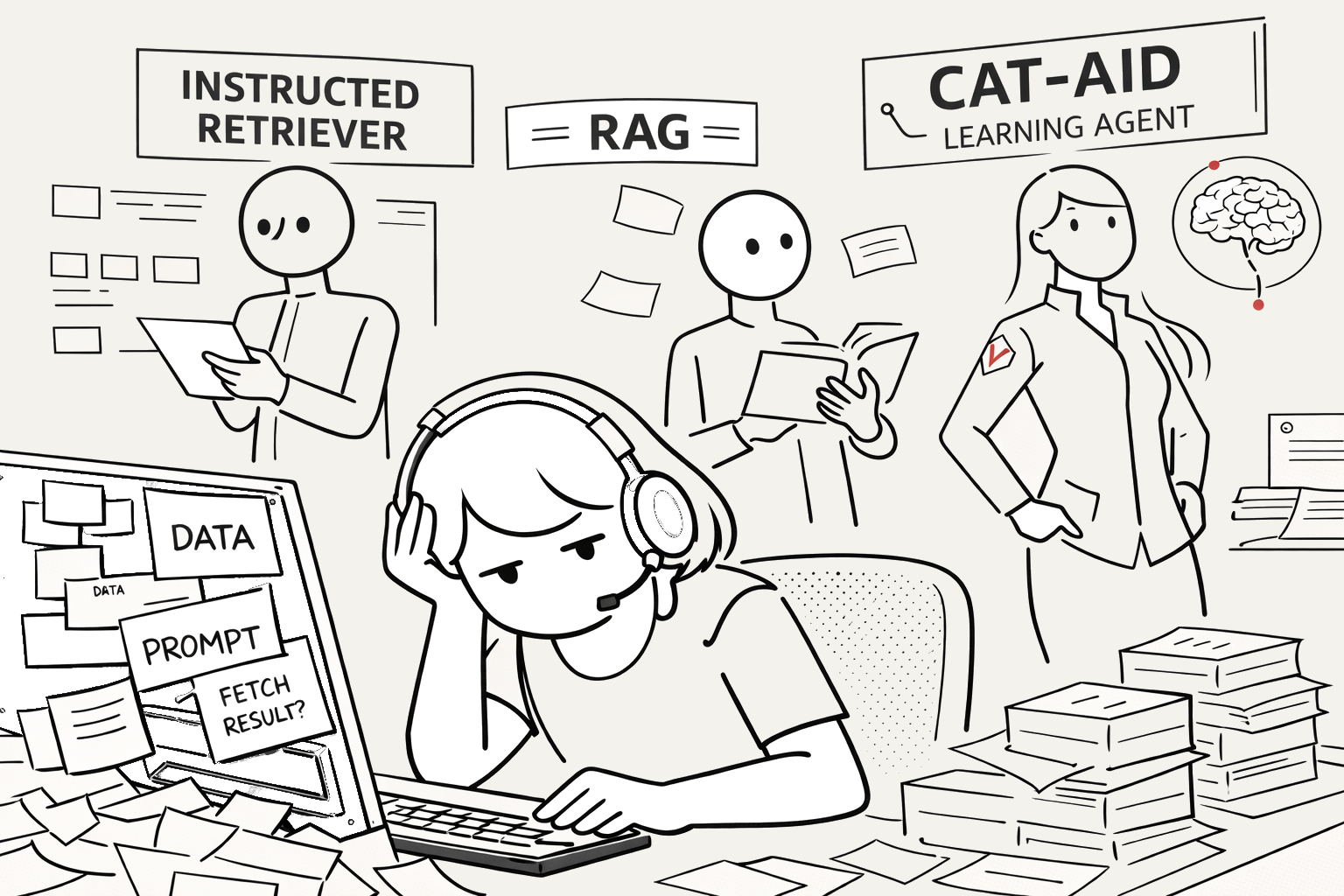
The idea of AI as a coworker is quickly moving from novelty to expectation. Agent frameworks, retrieval systems, and desktop assistants now promise something more than conversation. They promise help that persists across tasks, understands context, and operates with a degree of autonomy. In many ways, this progress is real and impressive. Yet beneath it lies a fundamental limitation that is easy to overlook. Most AI agents today do not actually learn. And without learning, no system can truthfully be considered a coworker you would hire.
This is not a criticism of recent innovation. The industry has made meaningful advances in execution, orchestration, and reliability. But it is important to distinguish between systems that appear adaptive and systems that actually change. Much of what we describe as progress in agents today is better prompt engineering rather than learning. That distinction is subtle, but it defines the ceiling we are now approaching.
Context windows are the most obvious example. They are often discussed as memory, but in practice they are closer to working memory. Everything the agent knows in a given moment must be explicitly present. If information is not injected into the prompt, it does not exist for the model. If it falls out of the window, it is forgotten completely. Increasing the size of the context window can delay forgetting, but it does not change the nature of the mechanism. As context grows, the model reaches a peak of coherent understanding, after which additional or conflicting information begins to dilute internal consistency and can increase the risk of hallucination, because this information is contextual, not actually trained. The system does not remember or learn. It is reminded.
This makes context windows necessary but fundamentally insufficient. They allow coherence over short horizons, but they do not support growth. A human coworker does not require you to re-explain lessons learned weeks or months ago. A system that relies entirely on context replay does. No matter how large the window becomes, the burden of remembering always remains external, and true learning never occurs.
Retrieval Augmented Generation (RAG) was an important step forward because it addressed a real problem. Models hallucinate when they lack grounding. By retrieving external documents and injecting them into the prompt, RAG improves factual accuracy and relevance. It allows agents to work against real data instead of relying on probabilistic guesswork. For many applications, this was a necessary breakthrough.
However, RAG is still replay. Retrieved information is not internalized. It does not alter how the agent reasons in the future. The system does not update its internal model of the world or refine its judgment. Knowledge must be fetched again the next time it is needed. If retrieval fails, the agent fails. Even when retrieval is perfect, the agent remains static. It knows more in the moment, but it has not learned. This limitation has led to increasingly sophisticated attempts to improve retrieval itself, rather than changing the agent.
Recent work such as instruction aware retrieval systems builds on this foundation by improving precision. Instructed Retriever (an extension of RAG) is a good example. Instead of treating retrieval as a generic similarity search, it incorporates system level instructions, metadata constraints, and intent directly into the retrieval process. This reduces irrelevant context and improves adherence to rules. For enterprise workloads, this is a meaningful improvement.
But even here, the underlying mechanism has not changed. Instructed Retriever is fundamentally a form of system level prompt engineering. It rewrites inputs before retrieval and post processes outputs after generation to enforce constraints. While this improves precision and reliability within predefined bounds, it is not a learning system. It does not adapt at runtime. It does not internalize experience. It cannot generalize beyond the behaviors explicitly designed and trained offline.
These approaches make agents better operators. They do not make them better coworkers over time.
Why AI Coworkers (i.e. Agents) Learning Matters
To understand why this matters, it helps to step back and ask what it actually means to be a coworker. We do not hire people because they can access more information than we can. We hire them because they learn how we work. They internalize preferences, standards, and judgment. They make fewer mistakes as they gain experience. Over time, they require less supervision, not more.
A system that does not learn cannot form trust. If it makes the same mistake twice, confidence erodes. If it requires constant reminders, it becomes a tool rather than a teammate. This is the ceiling that current agent architectures are now hitting. They simulate adaptation through better scaffolding, but the underlying system remains frozen.
The missing layer is learning during use. This does not mean unconstrained self modification. The industry is right to be cautious. Safety, stability, and predictability matter. Naive online learning introduces real risks. But avoiding learning entirely creates an equally severe limitation. Agents remain bound to their training, no matter how much experience they accumulate.
Without a mechanism for controlled adaptation, the past must always be replayed. Context windows grow. Retrieval systems become more sophisticated. Prompts become more elaborate. Yet the agent itself never changes. Intelligence becomes an illusion sustained by scaffolding.
LatentSpin was designed to address this gap directly. Its architecture is built on Conceptual Adaptation Theory (CAT), which treats learning as a regulated physical process of structural change driven by surprise and constraint. Instead of replaying experience through text, agents internalize it as a durable structure. Memory becomes weight rather than context. Judgment becomes policy rather than prompt.
Crucially, learning is governed. Internal control laws determine when adaptation is justified, how much structural change is permitted, and when stability must be restored. This allows agents to learn during operation without drifting into instability. Learning becomes bounded, predictable, and aligned with outcomes.
As a result, LatentSpin agents improve through use. They accumulate experience rather than replay it. They reduce supervision over time. They internalize institutional knowledge and domain specific judgment. Teaching an agent becomes similar to onboarding a new hire. Through natural interaction and feedback, behavior evolves and performance compounds.
This difference changes how agents fit into organizations. Instead of shipping static agents designed for narrow workflows, LatentSpin turns knowledge workers into agent creators. People teach agents how work is actually done, not how it was imagined at design time. Over time, these agents become deeply specific to the organization that trained them, creating durable value that cannot be copied by prompts or retrieval pipelines.
The industry is making real progress, and tools like large Context Windows, RAG, and Instructed Retrieval are important steps along the way. But tools are not coworkers. Coworkers learn. They adapt. They grow into their role. That is the difference between a system you use and a coworker you would hire. And that is the problem LatentSpin was built to solve.