Centralized Content Creation and Distribution has Limitations
For decades, media followed a simple and rigid model. A small number of institutions created content, and everyone else consumed it. Networks like CBS, NBC, ABC, and CNN controlled production, distribution, and narrative. This worked because access to distribution was scarce. If you owned the airwaves, you owned attention. But that model came with real inherent limitations. Content was expensive to produce, slow to update, and shaped by weak feedback loops. Most importantly, the audience had no ability to adapt or evolve the content. They could only receive it.
That broadcast model is now dying. Not because content stopped mattering, but because the assumptions behind centralized creation collapsed. The same structural transition is happening right now in artificial intelligence.
The first major break from broadcasting came with streaming platforms like Netflix. Streaming did not initially disrupt content creation so much as content distribution and optimization. Netflix personalized viewing, optimized recommendations, and removed scheduling constraints. Over time, it moved into original content creation, producing high quality shows and films at massive scale. This mirrors what we see today with advanced AI assistants and enterprise agent platforms. They are more polished, more capable, and more reliable than early models. They feel smarter because they are better curated.
Still Content and Distribution is Costly, Slow and often Unrelatable
However, Netflix still operates as a centralized studio. Content creation remains expensive, slow, and optimized for averages rather than individuals. The same is true for what many call co-worker agents in AI. These systems are general purpose, broadly useful, and impressive in demonstrations, but they do not truly belong to any single person or organization. They do not continuously learn. They do not accumulate durable knowledge. They do not evolve alongside their users. They can perform well, but they remain fundamentally static and more often than not, fall off the rails during long duration and sophisticated tasks.
This limitation becomes visible at scale. Netflix now spends billions of dollars annually to maintain relevance and viewership. Each improvement requires enormous centralized investment. Agentic AI systems built in this way face the same scaling wall. To compensate, they add larger context windows, more retrieval layers, more orchestration, and more guardrails. These techniques delay failure but do not eliminate it. Over long durations, agents drift where knowledge decays. They forget earlier decisions. They contradict themselves. They hallucinate under pressure. This is not a flaw in implementation. It is a structural consequence of stateless intelligence.
The real disruption in the media is not coming from streaming studios. It comes from YouTube. YouTube did not try to outproduce Hollywood. Instead, it became a platform that enabled fast and inexpensive creation. Individuals and companies owned their content, their narrative arcs, and their feedback loops from viewers. The audience became the creator. The platform scaled without centralized bottlenecks. In 2025, YouTube generated over 60 billion dollars in revenue from ads and subscriptions, significantly surpassing Netflix’s 45 billion. And compared to legacy broadcasters like NBC with revenue of 7.6 billion, the deeper disruption was not financial. It was architectural. Agency shifted from institutions to individuals.
Agents today are still largely stuck in the Netflix architecture. Most agent platforms are centrally designed, carefully handcrafted, and tightly controlled. Even when they appear adaptive, they are not learning. They simulate intelligence but do not compound it. This is why long-running agents fail in predictable ways. Healthcare agents forget patient context. Financial agents drift from risk constraints. Enterprise agents lose operational state. Knowledge agents hallucinate when conversations extend. Without durable training and continuous adaptation, coherence decays.
Adaptable Content and Distribution Curated by Domain Experts
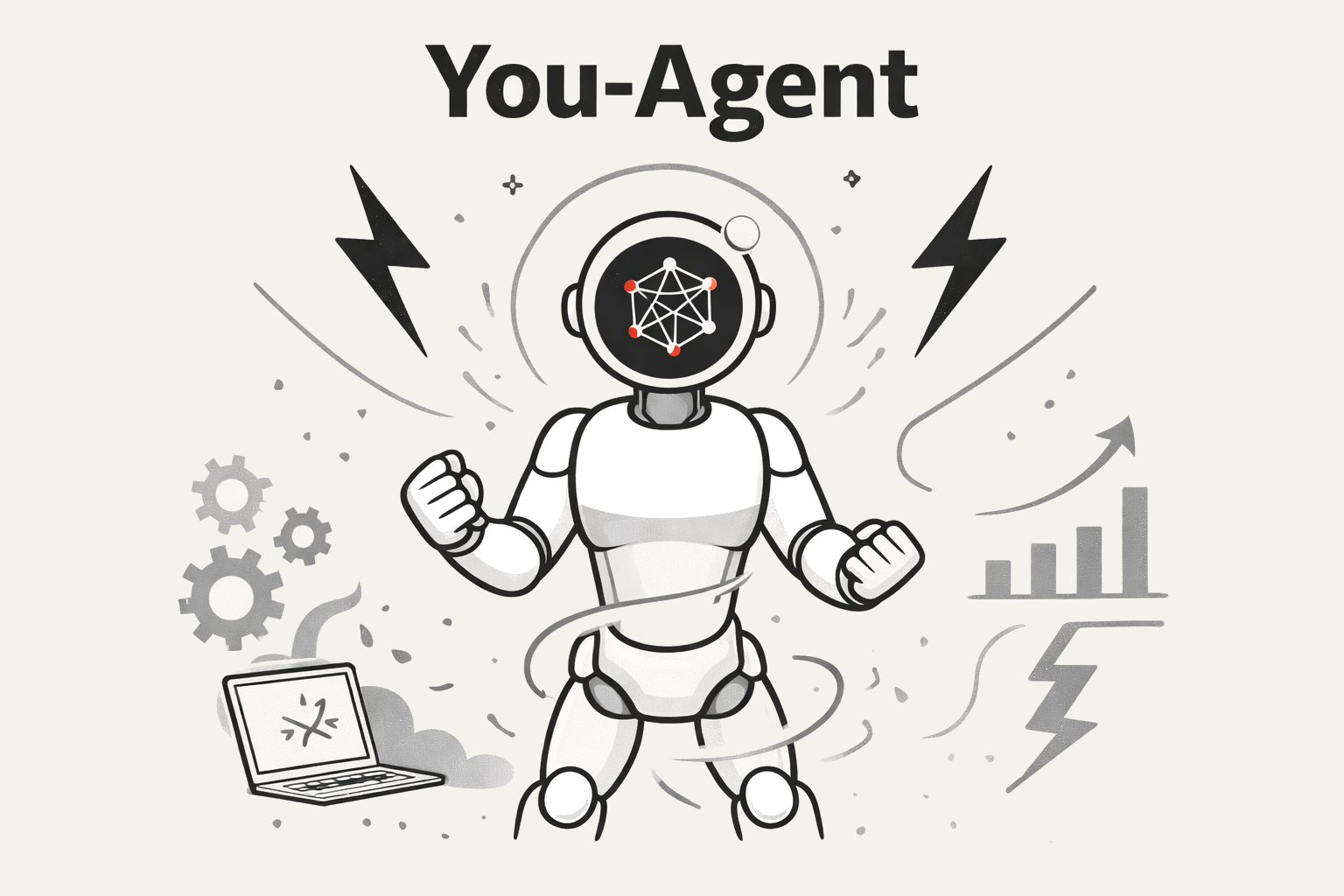
LatentSpin is built on a different thesis. The future of AI agents is not better co-workers. It is YouAgent (a.k.a. You-Agent). Just as YouTube allowed anyone who wanted to showcase their knowledge or creativity, LatentSpin enables individuals and organizations to move from consuming intelligence to shaping it when their work demands it. A You-Agent can begin as a helper, but over time it is owned, taught, and shaped by a knowledge worker who transfers intent, judgment, and domain understanding through everyday use. It learns from outcomes. It retains what matters and forgets what does not. It improves continuously through real work, rather than periodic offline retraining.
This distinction is critical. Context windows, retrieval systems, and orchestration layers are distribution mechanisms. They move information around but do not internalize it. Without learning, they can only delay decay. LatentSpin’s architecture introduces controlled, continuous learning so agents maintain identity, coherence, and intent across time. The difference is subtle at first but decisive at scale. One system resets after every session. The other compounds value.
Consider a long-running operational agent. A co-worker style agent tracks state within a session, pulls policies from retrieval, and performs well initially. Over days or weeks, it repeats mistakes, loses context, and requires manual correction. A You-Agent learns from each outcome. It updates its internal understanding, maintains long-term intent, and becomes more reliable with use. One scales linearly. The other scales exponentially.
Broadcast television did not disappear overnight, and Netflix will not either. But the center of gravity shifted. Today, most content is created by individuals, and platforms succeed by enabling creation rather than controlling it. AI is undergoing the same transition. The future question is not which company builds the smartest agent. It is who gives people the power to build agents that grow with them.
Netflix changed how we consume content. YouTube changed who creates it. LatentSpin is applying that same shift to intelligence itself. From static assistants to adaptive co-workers that learn, evolve, and compound alongside their creators. Once you see the difference, it becomes impossible to ignore.