For most of the history of computing, building an application has required a translation step. A business expert understands what needs to happen. A software engineer translates that understanding into code. The application then executes the code. That model has produced nearly every important software system we use today, but it also created a fundamental constraint: the people who know the work are usually not the people who can build the software that performs it.
Artificial intelligence is beginning to collapse that translation layer. The result is not simply better software or better automation. It changes the application, the work, and ultimately the role of the worker.
The most important shift may not be that AI can write better answers, generate code, or automate individual tasks. It may be that we are approaching a new application paradigm in which a person who understands the work can directly create, teach, and operate the system that performs it. That shift can be understood across three layers: App 3.0, Work 3.0, and Boss 3.0.
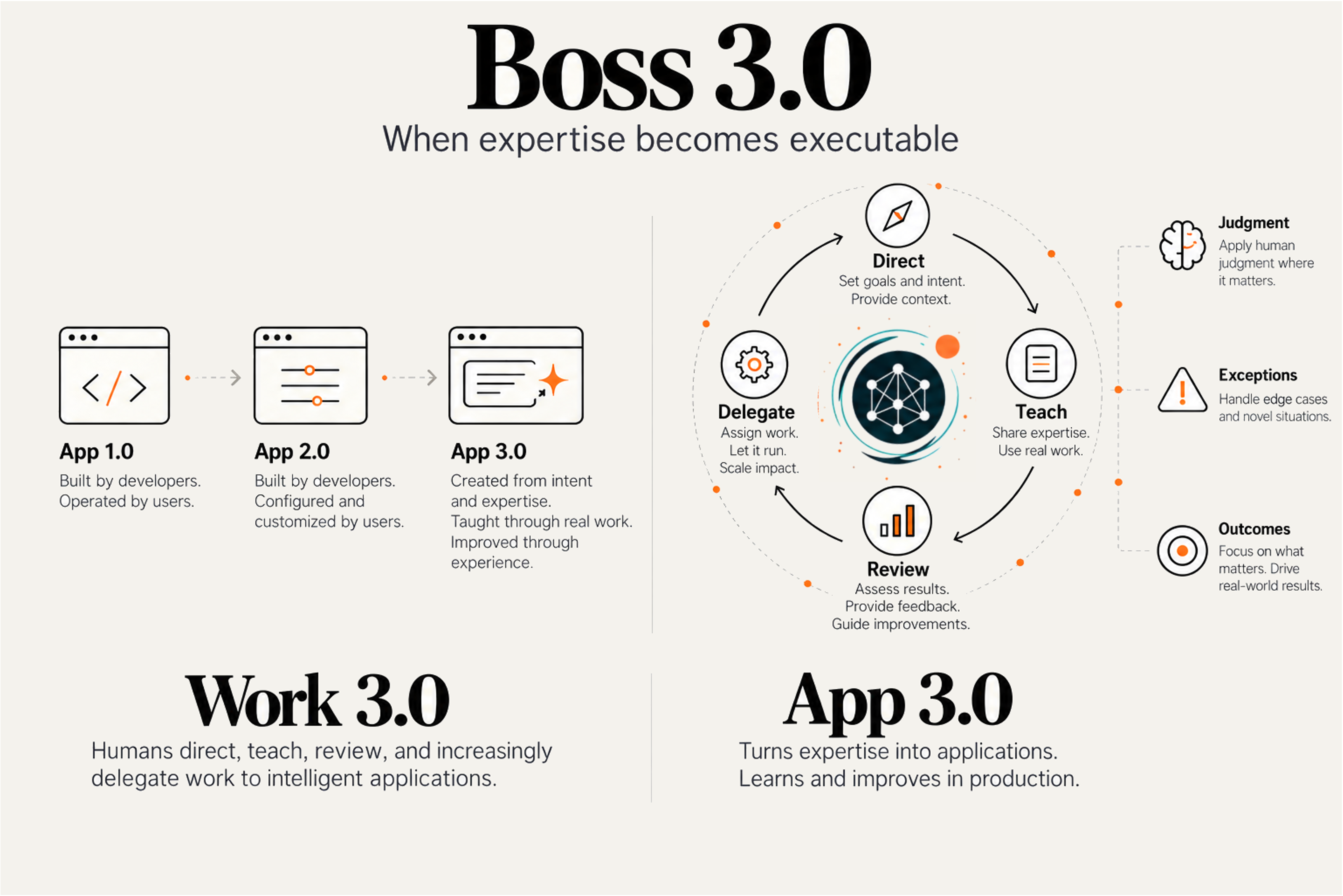
LatentSpin powers App 3.0 by automating Work 3.0 under the direction of Boss 3.0.
App:
• App 1.0: Built by developers. Operated by users.
• App 2.0: Built by developers. Configured and customized by users.
• App 3.0: Created from intent and expertise. Taught through real work. Improved through experience.
Work:
• Work 1.0: Humans perform the work.
• Work 2.0: Humans use software to perform the work.
• Work 3.0: Humans direct, teach, review, and increasingly delegate work to intelligent applications.
Boss:
• Boss 1.0: Manages people.
• Boss 2.0: Manages people and software-enabled processes.
• Boss 3.0: Directs and teaches intelligent workers. Focuses on judgment, exceptions, and outcomes.
The idea is simple. If you understand how a job should be done, you should increasingly be able to create the application that does it. You should not need to understand programming languages, agent frameworks, orchestration systems, model training, retrieval architectures, or machine learning. You should need imagination, domain expertise, and the ability to explain what you want.
Traditional software begins with code. App 3.0 begins with intent and expertise.
A knowledge worker might say, “Review this claim, gather the relevant evidence, determine whether the denial is valid, draft the appeal if appropriate, and ask me before submitting anything consequential.” Another might describe how to investigate a suspicious financial transaction. Another might explain how to prepare a tax case, resolve a logistics exception, or evaluate a compliance issue.
Those instructions are not merely prompts. They contain the beginnings of an application. They describe an objective, required information, business logic, judgment, actions, constraints, approvals, and an expected outcome.
Historically, a software team would have to extract those requirements, formalize them, implement them, integrate the necessary systems, test the application, and maintain it as the business changed. App 3.0 compresses that distance between expertise and execution.
The person who understands the work describes the objective. The system converts that intent into an explicit execution plan. It determines which steps are required, what information must be collected, which systems need to be used, where decisions need to be made, what evidence is required, when approval is necessary, and how failures or exceptions should be handled.
The result is still software in an important sense. Business logic is being represented and executed. State is being maintained. Systems are being called. Decisions are being made. Outputs are being produced. The difference is that the business logic does not have to begin its life as code written by an engineer.
Natural language becomes a development surface. That alone would be significant, but it is not the full shift.
Conventional applications are largely finished when they are deployed. They can be updated, of course, but improvement normally requires another development cycle. Someone identifies a problem, describes a change, modifies the software, tests it, and releases a new version.
In App 3.0, an application can instead continue to be taught through the work itself.
Imagine an experienced employee reviewing an agent's decision and saying, “That is not correct. This type of customer requires additional verification because the account was opened less than six months ago.” That interaction is more than error correction. It contains reusable expertise.
The system can preserve the correction, the explanation, the evidence, the context in which it applies, and the eventual outcome. If the lesson proves valid and generalizable, it can become part of how the application handles similar work in the future.
This changes the lifecycle of an application.
Instead of:
Specify. Build. Deploy. Maintain.
The loop becomes:
Describe. Create. Operate. Teach. Improve. Delegate.
The application is not simply configured once. It develops.
This is where the distinction between an AI agent and the broader application paradigm becomes important. Agents are the execution vehicle, but the larger idea is that human expertise can become executable business capability.
The application contains more than a workflow. It can embody judgment.
Traditional software is exceptionally good at explicit rules. If X happens, do Y. If a value exceeds a threshold, trigger an approval. If a field is missing, reject the transaction.
Real knowledge work is rarely that clean. Experienced people deal with ambiguity, exceptions, conflicting evidence, unusual circumstances, changing policies, and situations where the correct decision depends on context. Much of the value of expertise lives in those edges.
That is why simply generating workflows from natural language is not enough. A useful system must also have a way to absorb validated experience, become better at recurring classes of decisions, and preserve those improvements without turning every lesson into another prompt, rule, or document stuffed into a growing context window. The application therefore has two forms of logic.
One is explicit execution logic. These are the actions, dependencies, conditions, approvals, verification steps, and recovery paths that determine how work proceeds. The other is learned judgment. This is the accumulated understanding of how decisions and exceptions should be handled based on validated human expertise and operating experience.
Together, they create something closer to an executable representation of how an organization actually works. This also changes who can become a software creator.
The most important application builders in this paradigm may not be developers. They may be nurses, accountants, underwriters, investigators, lawyers, financial analysts, operations managers, customer-support specialists, and thousands of other professionals who have never considered themselves software builders.
Their advantage is not that they understand technology. Their advantage is that they understand the work.
The expertise that once had to be translated through specifications, tickets, workflow diagrams, and development projects can increasingly become the raw material of the application itself.
The application no longer needs to be built by an engineer. LatentSpin provides the execution, learning, governance, and infrastructure as a service. The domain expert creates the application by describing the work, connecting the necessary systems, and teaching it through real use.
A driver does not need to understand an internal combustion engine to operate a car. A spreadsheet user does not need to understand compiler design to build a financial model. In the same way, a knowledge worker should not need to understand agent architecture or machine learning to create an intelligent application. They should be able to explain what they want done, inspect what the system intends to do, correct it when necessary, teach it what matters, and gradually trust it with more responsibility.
That progression matters.
At first, the system may work closely with the expert. It asks questions, explains decisions, and requests frequent review. As it performs more work, receives corrections, observes outcomes, and demonstrates competence, the human can delegate more.
The relationship can evolve from “work with me,” to “work for me and ask when uncertain,” to “handle this class of work and bring me only the exceptions.” This may ultimately be the defining characteristic of Boss 3.0.
It is not simply software created with natural language. It is software whose creation begins with human expertise and whose development continues through human teaching and real operating experience.
For decades, software development has been about translating what people know into instructions machines can execute.
The next paradigm may collapse that translation. The people who know the work can become the people who build the application. And the application can keep learning from them.